

Work is the one price people in this province still trust without reading the fine print. Above Lake Louise, at 2,135 metres, a small tea house with no electricity pours tea every day of its season for people who have climbed 385 metres of trail to drink it, and they pay in cash.
Nobody makes them. There is a road to the Chateau and a lakeshore path that asks nothing of anyone. The line of hikers heading up toward Lake Agnes each morning in season has chosen the harder way on purpose, and that choice says more about what Albertans respect than any survey of their values could.
Key facts
- The Lake Agnes Tea House states that it was built in 1901 as a refuge for hikers, began serving tea in 1905 and replaced its original log building in 1981.
- Parks Canada lists the Lake Agnes trail from the Upper Lake Louise parking area at 3.4 km one way, with 385 m of elevation gain and a round trip of 2.5 to 3 hours.
- Banff and Lake Louise Tourism lists the Lake Agnes Tea House as open from June to October, cash only, with no electricity on site.
- Travel Alberta credits the Canadian Pacific Railway with building the Lake Agnes refuge in 1901 and lists the tea house elevation as 2,135 m.
Why people still hike 3.4 kilometres above Lake Louise for tea
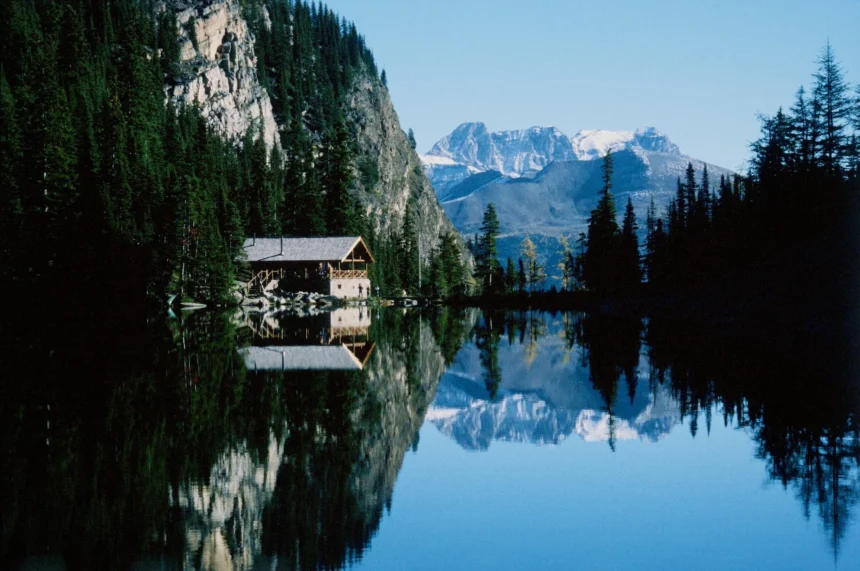
The climb starts where the crowds are. The trail leaves the shore near the Chateau and turns uphill into the forest, and within a few switchbacks the voices from the lakefront thin out to the sound of boots and breathing. It passes Mirror Lake. It climbs again. Then the trees open on a hanging valley where Lake Agnes sits behind a lip of rock, and on its shore stands the tea house, a log building whose windows, tables and chairs came out of the one the Canadian Pacific Railway put there as a hikers’ refuge in 1901.
Tea came four years later.
Everything on the table arrived by work. Fresh food goes up the trail on the backs of the staff, and the heavy dry goods, flour and propane among them, come in by helicopter once a year. The kitchen bakes every morning, and the family that runs the place offers more than 100 teas. There is no card machine because there is no power to run one. You pay with the paper you carried up.
What an uphill cup of tea says about how Albertans value work
In Genesis, work arrives as a sentence passed on Adam. In the sweat of thy face shalt thou eat bread. Most people in this province have never heard it as a punishment. A grain farmer who has swathed until midnight knows it, and so does a rig hand at the end of a fourteen-day hitch. Food eaten after work tastes different from food handed over a counter. The tea at Lake Agnes is ordinary tea. The climb is what seasons it.
There is a certain contempt in the way some people talk about places like this, as a postcard somebody in a marketing department invented. It is the same contempt that treats rural Alberta as a scenic backdrop for people who live somewhere else, and it misses the point entirely. The tea house has lasted more than a century because the people who climb to it understand the bargain it offers and like it. Visitors come to these mountains from everywhere, and the best of what they find up here was never built to be easy. Places that ask nothing tend to get treated accordingly, which is part of why crowds are wearing down Alberta’s hoodoos. A place worth reaching usually asks something of the person reaching it. Lake Agnes asks for an hour and more of uphill walking, a bit of cash and a willingness to sit on a hard chair at altitude with sore legs, and in return it gives a view of the valley and a hot cup that nobody had to plug in. Generations of hikers have looked at that trade and taken it. Plenty has changed on that trail since 1905. The walking has not, and neither has the plain satisfaction of setting down a pack after earning the right to.
The tea is worth only what it took to get there.
Frequently asked questions
How long is the hike to the Lake Agnes Tea House?
Parks Canada lists the Lake Agnes trail from the Upper Lake Louise parking area at 3.4 km one way, with 385 m of elevation gain and a round trip of 2.5 to 3 hours. The trail passes Mirror Lake before the trees open on the hanging valley where Lake Agnes sits.
When was the Lake Agnes Tea House built?
The tea house states that it was built in 1901 as a refuge for hikers, began serving tea in 1905 and replaced its original log building in 1981. Travel Alberta credits the Canadian Pacific Railway with building the refuge in 1901.
Is the Lake Agnes Tea House open year-round?
No. Banff and Lake Louise Tourism lists it as open from June to October. It is cash only, with no electricity on site, so there is no card machine to run.
How does food reach the Lake Agnes Tea House?
Fresh food goes up the trail on the backs of the staff, and the heavy dry goods, flour and propane among them, come in by helicopter once a year. The kitchen bakes every morning, and the family that runs the place offers more than 100 teas.
What is the elevation of the Lake Agnes Tea House?
2,135 metres, on the shore of Lake Agnes in a hanging valley above Lake Louise. The lake and tea house are named for Lady Agnes MacDonald, the original First Lady of Canada, who walked the path up to the lake in 1886.