

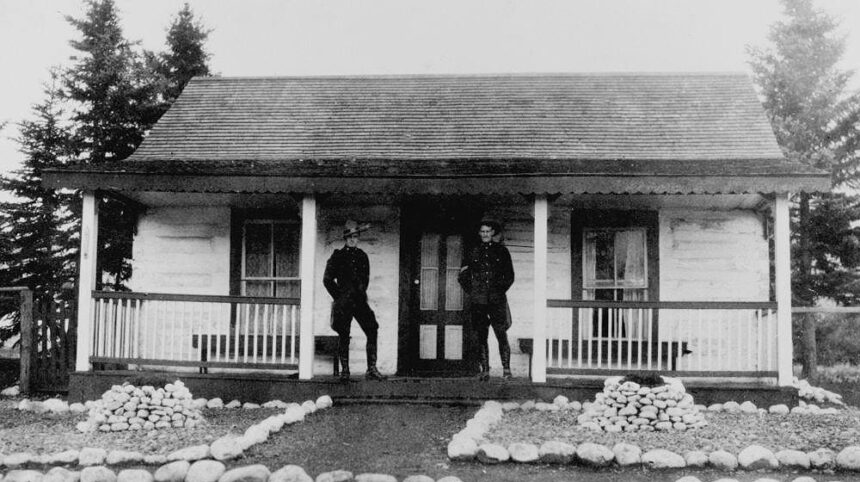
The Mounted Police arrived in southern Alberta in 1874 and in Calgary in 1875. They did not get to the Bow Valley west of Calgary until 1893. By the time the small log barracks went up on 8 Street in what is now Canmore, the town had been a working coal mining settlement for about six years. The Canmore NWMP Barracks is the physical record of the year federal law enforcement finally reached the mountain corridor that connected Calgary to the railway crossings of the Rockies.
Why the NWMP took so long
The Bow Valley west of Calgary did not have a significant settled population in the 1870s and 1880s. The Canadian Pacific Railway construction crews moved through quickly in the early 1880s. The Banff Springs Hotel opened in 1888. The Anthracite and Canmore coal mines opened in 1886 and 1887. By the time the mining communities were settled enough to need permanent law enforcement, almost twenty years had passed since the original Mounted Police arrival in the country.
The NWMP put a small detachment in Canmore in 1893 to handle the law enforcement needs of the coal mining community and the railway-era traffic moving through the corridor. The detachment was sized for a sergeant and a small number of constables. The barracks was sized to match.
The building specification
- Squared-log construction with chinked joints.
- A single storey footprint with two small rooms.
- A simple gable roof.
- Small window openings positioned for residential rather than defensive use.
- A connected stable for the detachment horses.
The structure is modest by any standard. It was built quickly and cheaply by local labour using local materials. It was intended to serve as the working base for the Canmore detachment for as long as the community needed a Mounted Police presence.
What the detachment dealt with
The Canmore detachment in the 1890s and early 1900s handled the standard mining community law enforcement portfolio. Wage disputes, drunk and disorderly cases, theft, the occasional homicide, and the more complicated periodic labour disputes that arose between the mining companies and the workers. The detachment also handled the seasonal traffic of tourists and railway passengers through the Bow Valley.
The barracks served the detachment until the early twentieth century when a larger building replaced it. The original 1893 log structure survived because it was repurposed as a community building and then as a heritage site.
The building is a designated Provincial Historic Resource and is listed on the Canadian Register of Historic Places as Site ID 4999.
The Mounted Police followed the economy
The standard story of the NWMP in Alberta focuses on the 1874 March West, Fort Macleod and Fort Calgary. The later arrival of federal law enforcement in the corridors that became the Bow Valley mining communities is usually treated as an afterthought.
The truth is that the Mounted Police arrived in different parts of the province at different times based on where the communities and the commerce actually were. Southern Alberta got the early attention because the whisky trade was there. The Bow Valley waited for the mining boom to make the federal presence worthwhile.
The Mounted Police arrived in Canmore in 1893 because the coal mining and railway activity finally justified the cost. The economy went first, and the federal presence followed.
The small log barracks in Canmore is the physical proof. The Mounted Police did not get there first. They got there when the economy made the deployment necessary. The building is worth a stop if you are passing through Canmore.
Related reading from the series. Ralph Connor Memorial United Church and the Canmore building named for a bestselling novelist. Fort Macleod and the first NWMP outpost in southern Alberta.