


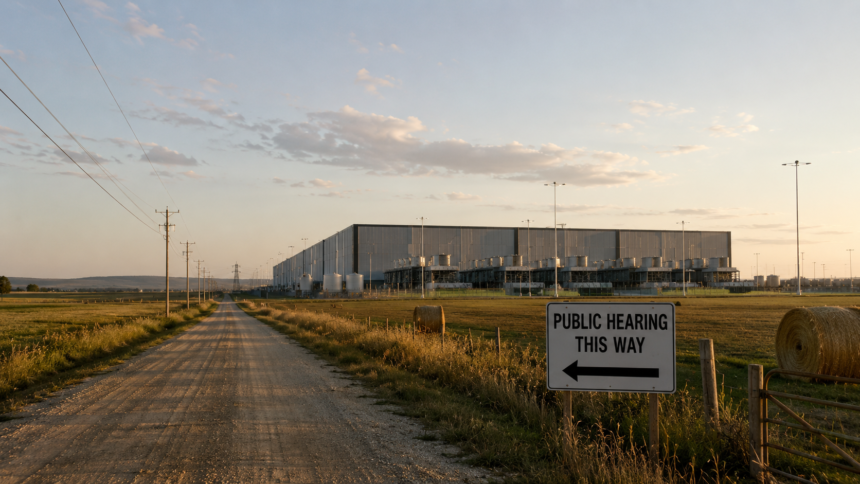
Decisions belong to the people who live with the result. When a data centre project worth hundreds of millions of dollars wants to set up beside a small town, the plain question is who holds the pen, the town or someone in Edmonton. For a province that talks constantly about local control, the answer should be easy.
So far the system has mostly respected that. At Olds, the Alberta Utilities Commission, the provincial regulator handling the power plant beside the proposed data centre, widened the rules so that anyone living in the town could take part in the hearing, rather than only the handful within a narrow radius. That is the system working.
Key facts
- The Town of Olds announced on December 18, 2025 that Data District Inc. plans $200 million to $300 million of investment in an Olds data centre in 2026, according to its municipal announcement.
- The same announcement describes a further $500 million over four to five years that depends on a planned 55 MW power expansion with FortisAlberta, the Town of Olds states.
- The Town of Olds projects about 70 permanent positions at the Olds data centre by the end of 2026 and about 150 by 2029 to 2030, per the same town release.
Subsidiarity is a conservative instinct
Deciding at the most local level capable of making the decision is how rural Alberta has always preferred to run its affairs. The people who live next to a project know the roads, the water table, and the character of the place better than any deputy minister. They also have to live with the result long after the press release fades. Handing their decision to a distant office because a project is deemed too important is exactly the centralizing reflex Albertans resent when Ottawa does it.
The temptation will be to fast-track
The risk arrives the moment a marquee investment stalls at a council table. The pressure to speed things up, to create a provincial approval that bypasses the locals, to declare certain projects above municipal review, will be real. It should be resisted. A province that overrides its own towns to please investors teaches every community that its vote is provisional, and it is setting up exactly the land fights that careful local process is meant to prevent.
Set the table, do not flip it
There is a proper role for the province here. Set clear province-wide standards on water, grid costs, and environmental performance, give municipalities the tools and the technical help to evaluate proposals they have never seen the likes of, and then let them decide. That is how Alberta lands this industry without hollowing out the local democracy that makes small towns worth living in. A yes that the community chose is worth ten that were imposed, which is the whole reason a town deserves a real seat at the table.