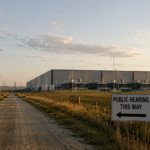



A city that will fine you for missing its deadlines spent five weeks unable to keep its own website upright.
Between May 21 and June 1, the industry association representing the region’s homebuilders, BILD Calgary Region, sent out three separate notices on the same subject. Not three notices about three problems. Three notices about one problem that kept coming back, like a relative at Christmas who has heard the hints and stayed anyway.
The systems involved are called Vista and ePermit. Between them they handle Residential Improvement Projects and Single Construction Permit applications, which is the municipal way of saying they handle the paperwork for very nearly everything anyone wants to build in Calgary, from a basement development to a house.
The third notice came with a number on it
The June 1 message went out as Industry Update 2026-33, which suggests the association has had rather a lot to update the industry about this year.
The City’s account of events was a small masterpiece of the form. Progress made in stabilizing the system. Early indications that external access was stable. And then the line doing all the heavy lifting, the warning that the system may keep running slower than usual because demand remains high.
High demand. On a permit portal. In a city that has spent two solid years telling everyone within earshot that it wants more housing built faster. Who could have seen it coming.
Staff, the public was assured, were addressing the backlog created during the outage. How big was the backlog? Unpublished. How long was the outage? Also unpublished. The City announced it had cleaned up the mess without ever announcing the size of the mess, a management technique with an extremely bright future ahead of it.
The contingency plan was a phone number
Applicants with files stuck somewhere inside the machinery were referred to 311 and to the Planning Services Inquiries Centre, with outage updates posted on the City of Calgary website.
There is nothing wrong with 311. It is a fine service, staffed by people doing their best. There is nonetheless something faintly wonderful about a digital permitting platform whose backup plan, in its hour of need, is the same telephone line you would use to report a pothole.
Modernization arrives with a slide deck. It departs with a call queue.
Deadlines, but only in one direction
Now consider the asymmetry, which is where every good municipal story eventually lands.
A builder who submits late pays for it in weeks of carrying costs on serviced land. A builder who submits the wrong version pays for it. A builder who misses a resubmission window pays for it. And a builder who did everything correctly, on time, in the right format, and then met a portal that would not open, pays for that as well.
Four different failures, one party absorbing the cost every time, and it is never the party running the server. The interest on a construction loan does not pause out of sympathy for an outage.
Alberta went to the trouble of setting a 120-day approval timeline precisely so that files would stop vanishing into the process for seasons at a time. A clock like that is a fine thing. It is also of limited use when the door to the building is locked and nobody will say for how long.
None of this is the fault of any individual at City Hall. Systems fail. Vendors ship bad updates on Friday afternoons. Servers pick inconvenient moments to retire. Nobody sensible expects a municipality to run flawless infrastructure forever. The complaint is narrower than that, and harder to wave off. It broke, then it broke again, then it broke a third time, and the public record still contains no number attached to any of it.
Somebody, at least, wrote it down
The one genuinely encouraging detail here is the paper trail. May 21. May 27. June 1. Three timestamped notices, circulated across an entire industry, describing a public system in a state of repeated collapse. BILD Calgary Region kept the receipts, which is more than can be said for the outage log.
This matters more than it looks. Calgary is in the middle of a construction cycle that has done more for affordability than most programs announced from a podium. The Calgary housing market has finally started giving buyers room, and it got there on volume, which means it got there on permits.
Every week a file sits in limbo is a week of that volume going nowhere. Multiply by five weeks and an unstated number of applications, and you have a cost the City has managed to impose without ever having to write it down.
Calgary has committees on housing. It has frameworks, plans and engagement phases on housing. What it did not have, for five weeks this spring, was a functioning front door.
Related from Alberta Tribune: Open For Growth Is A Promise Approval Times Have To Keep