

Energy policy in Alberta is not a theoretical discussion held in committee rooms. It is payroll in Fort McMurray. It is municipal revenue in Grande Prairie. It is equipment orders, hotel bookings, and small business survival across the province.
When federal regulations tighten, when emissions caps are debated, and when global markets shift, the consequences do not stop at the wellhead. They reach households.
The central question is simple. Will energy policy protect Alberta jobs while keeping the sector competitive in a changing global market.

Jobs, Competitiveness and Reality
Alberta’s energy sector remains one of Canada’s largest private employers and a primary source of export income. Oil and gas activity supports direct jobs in production and refining, and indirect employment in construction, transportation, engineering, manufacturing, and services.
At the same time, global energy markets are evolving. Investors are demanding lower emissions intensity. Major trading partners are advancing carbon border adjustments. Capital flows are increasingly tied to environmental performance and regulatory certainty.
If policy is overly restrictive without offering clarity, investment hesitates. If it ignores environmental pressures entirely, capital looks elsewhere.
Competitiveness now depends on both cost efficiency and credible emissions strategy.
Regulation and Innovation Are Not Opposites
There is a tendency to frame energy policy as a choice between regulation and growth. That framing misses what has already happened in Alberta.
Over the past two decades, producers have reduced emissions intensity per barrel through improved extraction techniques, better monitoring systems, and operational efficiency. Technologies such as carbon capture, solvent-assisted recovery, and methane leak detection have moved from pilot projects into active deployment.
Innovation has often been driven by regulatory pressure combined with market incentives. When policy is clear and consistent, companies invest to adapt.
The risk arises when rules are uncertain or layered without coordination. Capital budgeting cycles in energy are long. Projects require billions in upfront investment. Companies need to know the regulatory framework will remain stable over the lifespan of those investments.
The Economic Stakes
Energy royalties fund hospitals, schools, and infrastructure. Municipalities rely on industrial property tax. Small businesses depend on sector activity to sustain local demand.
A strategy that constrains production without providing a viable growth pathway risks reducing both employment and public revenue. A strategy that ignores emissions performance risks market access and investor confidence.
Responsible growth requires acknowledging both realities.
Canada’s emissions goals are part of federal policy. Alberta’s economic structure remains deeply tied to resource development. The solution cannot be to freeze development in place. Nor can it be to dismiss environmental commitments as irrelevant.
The objective should be to align competitiveness with credible emissions reduction.

Policy Must Balance Signals
Energy policy must send three signals clearly.
First, Alberta remains open for investment. Regulatory clarity, efficient approvals, and predictable tax structures matter.
Second, emissions performance will improve through technology, not through arbitrary production ceilings that distort markets.
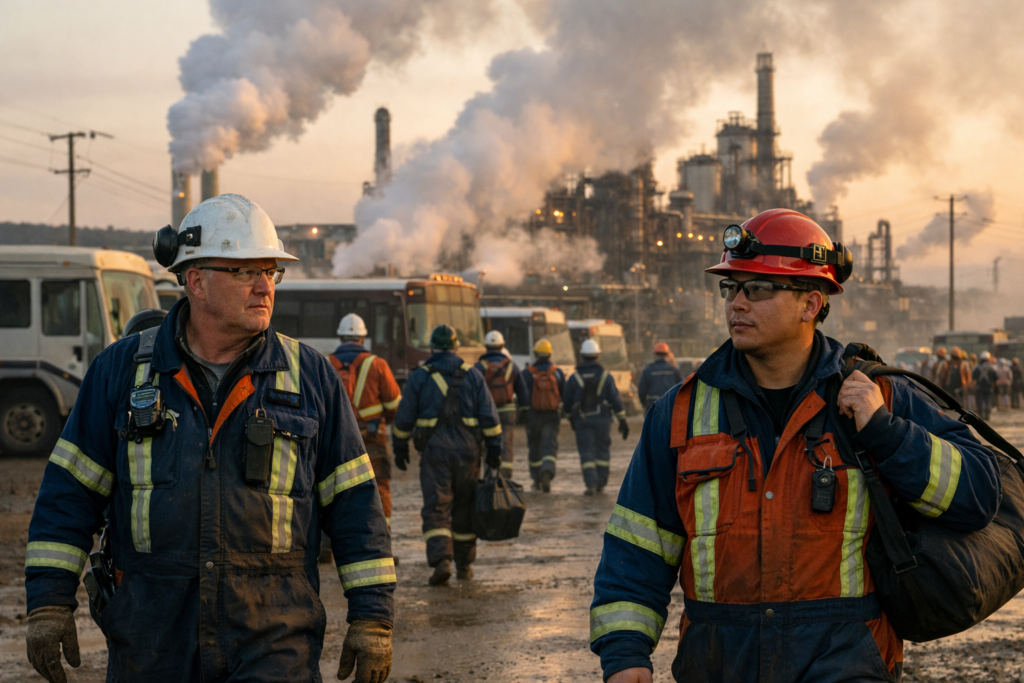
Third, workforce stability is a priority. Skilled trades, engineers, and technical workers need confidence that long term employment opportunities exist in the province.
If these signals are consistent, capital adapts. If they conflict, investment slows.
Growth With Accountability
Responsible growth means expanding production where economically viable, investing in emissions reduction technology, and supporting workforce transition where necessary. It does not mean managed decline. It does not mean ignoring environmental standards.
Alberta’s energy sector has shown resilience through price collapses, pipeline constraints, and global downturns. It has modernized operations and improved efficiency under pressure.
The next chapter depends on whether policy frameworks recognize that economic strength and environmental performance can advance together.
The stakes are not partisan. They are economic.
Protecting Alberta jobs requires competitiveness, regulatory clarity, and innovation aligned with market realities. Energy policy should be measured against that standard.