

Of all the fur trade sites in Alberta, only one has the original buildings still standing on the original ground. That site is Fort Dunvegan. The fact is rare enough to be worth saying directly. The province has lost almost every other piece of its fur trade architecture to fire, demolition, neglect, or what is politely called development. Dunvegan kept its buildings. You can walk through them today.
1805 on the south bank of the Peace
Fort Dunvegan was established in 1805 by the North West Company on the south bank of the Peace River, in what is now Dunvegan Provincial Park. Source is Parks Canada, Canadian Register of Historic Places ID 18983. After the 1821 merger, the Hudson’s Bay Company continued to operate the post under its own management. Dunvegan ran as an active working fur post for the better part of a century, which by Alberta standards is an extraordinary continuity record.
What survives that you can actually walk through
Three nineteenth century buildings stand on the site.
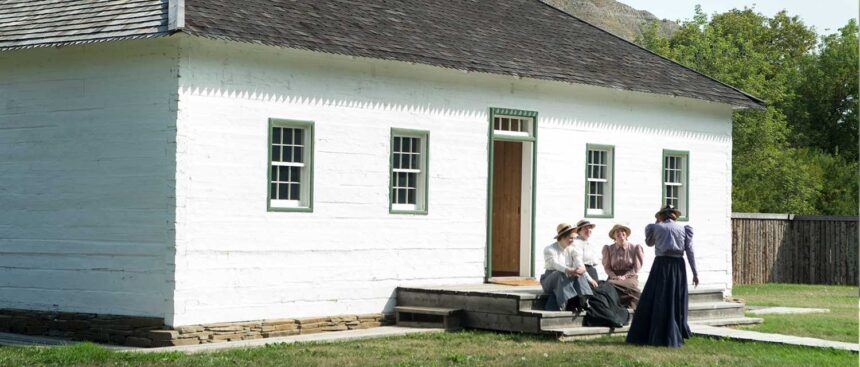
The 1877 factor’s house
The factor’s residence dates to 1877 and reflects HBC-era post construction. It is the building most often photographed at the site, and it is the closest thing Alberta has to an intact fur trade era dwelling.
The 1885 mission and rectory
A Roman Catholic Mission church and a matching rectory were built in 1885, reflecting the layering of religious institutions on top of the fur trade infrastructure that was typical of the late nineteenth century in this part of the country. Both buildings still stand. Both buildings are accessible.
Why this kind of preservation is rare in Alberta
The province has a long habit of treating old buildings as obstacles. The reasoning is usually some version of cost, safety, or land value. Dunvegan survived for a combination of reasons. It sits inside a provincial park, the buildings were owned by institutions that did not need to sell them, and a generation of dedicated heritage staff at Alberta Parks did the unglamorous work of keeping the structures weather-tight for decades. None of that was inevitable. Alberta could easily have lost Dunvegan the way it lost the original Fort Edmonton.
The site was designated a National Historic Site of Canada on May 21, 1947.
My take on what the province should do next
Here is the part where you get the heritage buff opinion direct. Alberta should treat Dunvegan as the template, not the exception. There are a handful of nineteenth century building clusters in this province that could still be saved with active intervention. Almost all of them are at risk because they sit on private property or on parcels with development pressure. The Dunvegan model proves that preservation in place is possible if there is political will and a small recurring budget. The province should pick three more sites this decade and apply the same approach. Once an original building is gone, no reconstruction puts it back. Dunvegan is the proof that the right answer is keeping the original on its ground.
Worth the drive if you are in the Peace country. Worth the drive even if you are not.
Listed on the registry. Fort Dunvegan appears on the Canadian Register of Historic Places as Site ID 18983 and was designated a National Historic Site of Canada on May 21, 1947. The site is administered today as Dunvegan Provincial Park.
Related reading from the series. Fort Chipewyan III and the 1803 move that finally stuck. Fort White Earth and shared palisades in hard country.