


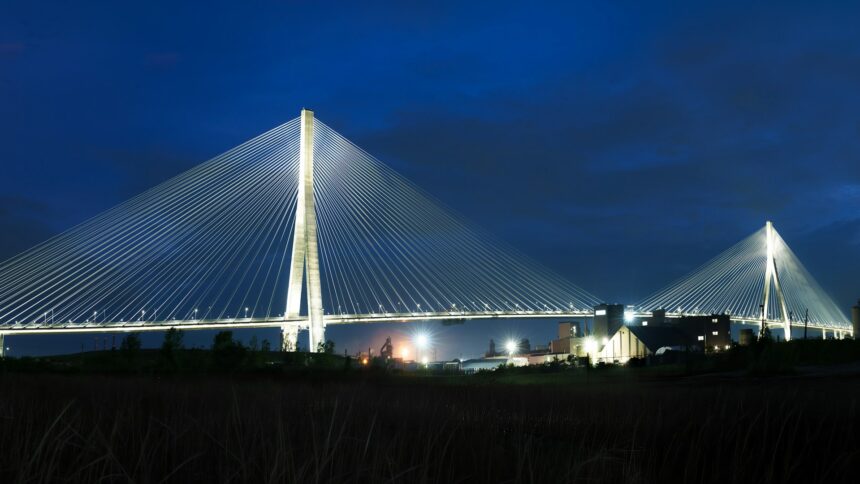
“All revenues collected with respect to the bridge, less all incurred operating costs.”
That sentence is the definition of net revenue in the proposed agreement in principle between Canada and the United States on the Gordie Howe International Bridge, posted this week by the Windsor-Detroit Bridge Authority. Half of whatever survives it goes to a fund controlled by the American government, for the first 15 fiscal years of operation. The bridge, which Canada financed on its own at a cost of about $6.4 billion, is due to open to traffic on Monday.
Read the sentence again for what it omits. Operating costs come off the top, as they should. The construction debt, the $6.4 billion that made the thing stand up over the Detroit River, appears nowhere in the text at all.
Key facts
- The proposed agreement in principle between Canada and the United States, published by the Windsor-Detroit Bridge Authority in July 2026, directs 50% of net bridge and crossing revenues to a United States-Canada Economic Development Fund for the first 15 fiscal years of operation.
- That agreement defines net revenues as all revenues collected for the bridge less incurred operating costs, and it contains no clause recovering construction costs before the split.
- Under the same proposed agreement, the Windsor-Detroit Bridge Authority must seek United States consent for toll increases above 10% a year during those first 15 fiscal years.
- The agreement text sets the opening of the Gordie Howe International Bridge to commercial and passenger traffic on or before July 27, 2026.
- A White House fact sheet dated July 20, 2026 announced 50% tariffs on a range of Canadian goods under Section 338 of the Tariff Act of 1930, with energy and potash exempt.
What the federal explanation promised before the text arrived
On July 16 the Prime Minister described the split as something that “won’t happen until all of the debt is repaid.” Six days later the text was published, and the debt had been cleared from it with the tact of a butler removing a plate nobody wished to discuss. Ottawa has since explained that the debt-first language described the older crossing arrangement with the State of Michigan, under which Canada recovers its costs from tolls before anyone else is paid. The explanation is accurate about the old deal. It says nothing about the new one.
On Thursday came the concession that he should have been clearer, followed by a fresh reassurance. The cost to Canada, the government said, is less than 5% of the project in present value, roughly $320 million over 15 years. By our arithmetic that works out to about $21 million a year, which is the sort of sum a finance department can describe as modest while still preferring to keep it.
Consider the theory of ownership on display. A duke builds the chapel, pays the organist, heats the nave, and then invites the neighbouring estate to take half the collection plate for 15 years, net of candles, on the grounds that the plate is small. The plate is indeed small. The precedent is larger.
Why a toll clause belongs in the tariff conversation
The clause that deserves the most attention is the one about prices. For 15 fiscal years, the Canadian authority that owns the bridge must ask Washington before raising tolls by more than 10% in a year, or before straying from regional averages. Canada has built a cathedral and handed the parish next door a veto over what the pews cost.
That would be a curiosity if it sat alone. It does not. Four days before the text appeared, the White House announced 50% tariffs on a broad range of Canadian goods, due to take effect 30 days after signing. Energy and potash were left out, which is why Alberta’s largest exports sit outside this round, a point made here when Washington tariffed the honey and tiptoed around the barrel. Alberta manufacturers and food processors have no such exemption, and the same federal trade apparatus that produced the bridge terms now carries their file.
Albertans will mostly never drive the Gordie Howe bridge. They paid for it anyway, through the same federal revenue that pays for everything Ottawa builds, and that part is simply how a federation keeps its accounts. What they are entitled to ask is how a negotiating team treats a file in which Canada held the only chequebook, the only title and the only shovel. The answer, on paper, is that it gave away half the net revenue and a say over the prices.
Governments survive bad bargains all the time. They struggle with the habit of describing a bargain before anyone has read it, and the first ministers who met in Charlottetown this week, with the tariff clock already running, should want every description checked against every text.
What the numbers say about the price of goodwill
There is a defensible case for goodwill at a border. Bridges have two ends, customs plazas need cooperation, and a crossing that one side resents is a poor crossing. The agreement in principle may even have bought the opening date, which the text fixes on or before July 27. That is a real thing to have purchased.
But the purchase should be priced honestly. Ottawa’s own defence is that the money is small, a rounding error in a $6.4 billion project, and on that narrow point Ottawa is correct. Twenty-one million dollars a year will not trouble the federal treasury.
The expensive item in the agreement is the one with no price attached, a 15-year veto over Canadian tolls that Washington received free of charge.