

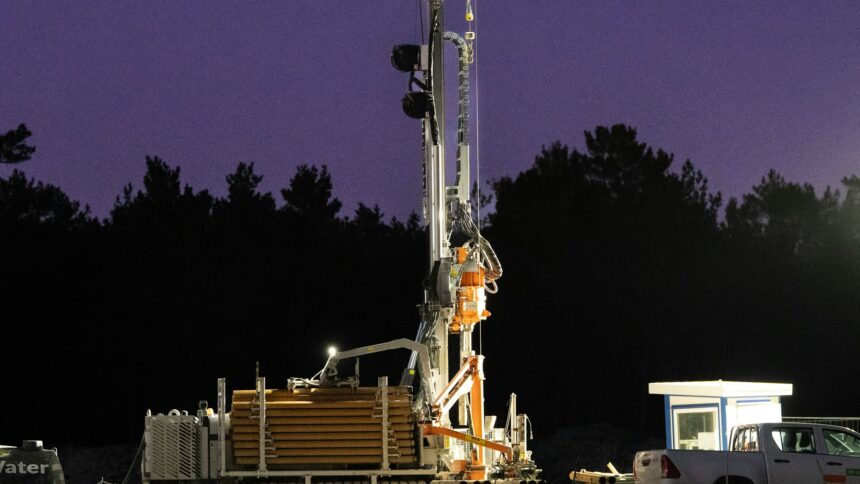
In 1947 this province was handed a resource it had done almost nothing to deserve, and the thing that decided what happened next was not the geology. Imperial Oil’s Leduc No. 1 came in on 13 February of that year, on a farm near Devon, after 133 dry wildcat wells drilled across Alberta over roughly three decades. The oil had been down there the whole time. What changed was that somebody kept drilling, and that when the well came in there were people here ready to build on top of it rather than watch the rigs arrive from somewhere else.
Key facts
- Imperial Oil’s Leduc No. 1 came in on 13 February 1947 near Devon, following 133 dry wildcat wells drilled in Alberta over roughly three decades, per Canada’s Historic Places.
- By the end of 1957 Alberta held 85% of Canada’s crude oil reserves, with cumulative production of 137 million barrels, per Alberta’s Energy Heritage.
- The Government of Alberta had taken in about $625 million in petroleum royalties between 1947 and the end of 1957, per Alberta’s Energy Heritage, with roughly 16,000 people directly employed in the sector in that period.
- Statistics Canada’s Canadian Survey on Business Conditions for the second quarter of 2026, released 27 May 2026, reports artificial intelligence use at 21.0% of urban businesses and 9.9% of rural businesses.
- ATB Financial, reading Statistics Canada table 33-10-1167-01, puts Alberta business artificial intelligence use at 18.4% in the second quarter of 2026 against 19.2% for Canada.
Ten years is how long the window stayed open
The figure worth holding onto is not the discovery; it is the decade that followed. By the end of 1957, ten years and ten months after that flare was lit, Alberta held 85% of the country’s crude oil reserves and had collected roughly $625 million in petroleum royalties. Cumulative production stood at 137 million barrels. Sixteen thousand people worked in the industry directly. None of that was inevitable in February 1947, and a good deal of it could have gone elsewhere; the refining, the engineering firms, the service companies and the head offices were all portable, and other jurisdictions with comparable geology ended up as suppliers to somebody else’s economy rather than as the centre of their own.
What kept it here was a run of unglamorous decisions taken while the boom was still small enough to shape. A conservation board with real authority. A royalty regime written before the leverage disappeared. Training, credentialling and a university that turned out the people the industry needed. The province decided to be the place where the capability lived, not merely the place where the substance was, and the distance between those two outcomes is the distance between Alberta and every resource region that ended up poorer than its geology.
The same offer is on the table and the take-up rate is middling
Alberta is now being offered a second version of the same trade, and the early numbers are not flattering. Statistics Canada’s second quarter survey for 2026 puts business use of artificial intelligence at 18.4% in Alberta against 19.2% nationally, which by our own arithmetic leaves this province eight tenths of a percentage point behind the country it is supposed to be leading on the technology file. The rural split is worse and more revealing; 21.0% of urban businesses against 9.9% of rural ones, with agriculture, forestry, fishing and hunting at 4.5%, the lowest of any industry group reported.
Those are adoption figures, not investment figures, and the distinction is the entire point. Alberta is doing well at attracting the physical substance of this industry, the campuses and the megawatts and the capital announcements, in much the way it attracted drilling capital in 1948. The question 1957 answered, and that nobody has answered this time, is whether the businesses already operating here end up using the thing or merely hosting it. A province can sit on top of an enormous amount of compute and still run its own firms at below the national adoption rate, and if that persists for a decade it will not matter how many campuses got built.
Hosting and owning are different economies
This province has made the distinction badly before. Hosting pays construction wages, property taxes and a levy; it is real money and it should not be sneered at. Owning pays for forty years, because the firms that build capability around a resource keep earning after the resource stops being novel. Alberta energy is the proof of the second proposition, and the proof took until roughly 1960 to become visible, which is precisely why nobody notices they are in the window while they are standing in it.
The 1957 figures were compiled by people who had no idea they were describing a settled outcome; they believed they were writing up a good year. That is the difficulty with a window. It is only visible from the far side, and the decisions that determine what a province keeps are taken in years that feel entirely ordinary at the time, by people who are busy with something else.
In 1947 the resource was under the ground and the capability had to be built on top of it; the same is true now, and Alberta business has about a decade before the answer hardens.
Alberta has been lucky twice. Luck is not a strategy, and it does not come a third time.