


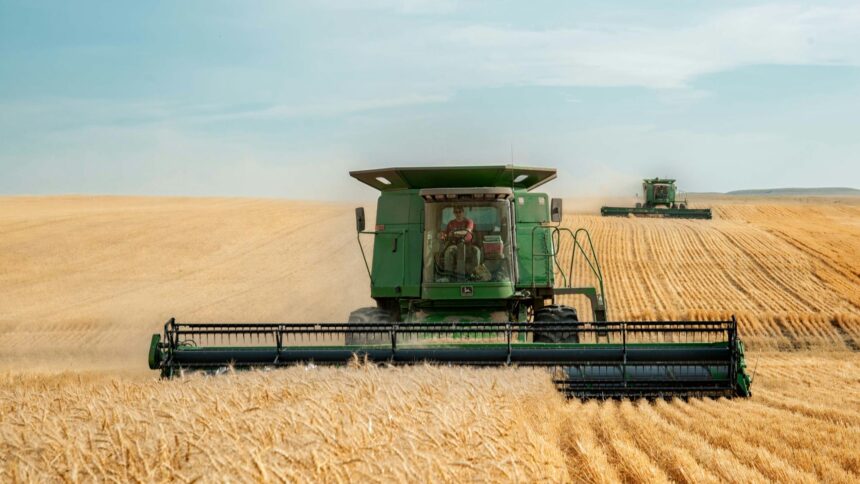
The largest unclaimed productivity gain in this province is sitting in places with no conference centre. Statistics Canada put artificial intelligence use at 9.9% of rural businesses in the second quarter of this year, against 21.0% of urban ones. Variable rate application driven off yield maps is ordinary equipment on a mid-sized grain operation in this province. So are automated calving cameras, guidance systems that hold a line to within a few centimetres, and grain marketing services running models the operator never sees and never asked to see. By that survey’s measurement, a farm using all four of those is a non-adopter. The number is not wrong. The number is measuring something narrower than the people it describes.
Key facts
- Statistics Canada’s Canadian Survey on Business Conditions for the second quarter of 2026, released 27 May 2026, reports artificial intelligence use at 9.9% of rural businesses and 21.0% of urban businesses.
- Agriculture, forestry, fishing and hunting recorded artificial intelligence use of 4.5% in that survey, the lowest of the industry groups reported, against 42.3% for information and cultural industries and 40.4% for finance and insurance.
- Responses were collected between 1 April and 6 May 2026, drawing 9,251 responses from a sample of 21,105 employer businesses, with the artificial intelligence question covering the preceding 12 months.
- The same Statistics Canada table, 33-10-1167-01, recorded rural use at 3.3% and urban use at 6.7% in the second quarter of 2024.
- Statistics Canada’s published analysis of the second quarter 2026 results does not set out where the boundary between rural and urban businesses falls.
The rural rate is rising as fast as the urban one
Everyone quotes the gap. Almost nobody runs it backwards. Two years ago rural business use stood at 3.3% and urban at 6.7%. Rural has tripled since. Urban has roughly tripled since. By our own arithmetic the rural rate is climbing at essentially the same multiple as the urban one, which means the story being told about rural businesses refusing to move is not supported by the series the storytellers are quoting from.
What has changed is the absolute distance. The gap was 3.4 percentage points in 2024 and it is 11.1 points now, also our arithmetic, and it widened for the ordinary reason that the same growth rate applied to a bigger base produces a bigger increase. A man running to catch a train that is accelerating does not become slower by failing to catch it. The people writing about this file keep describing a reluctance where the data shows a head start.
There is a second thing in that release worth sitting with, and it is the kind of detail that ordinarily goes unremarked. Statistics Canada’s own analysis of these results does not say where rural ends and urban begins. The most quoted divide in the Canadian technology conversation runs along a line the agency publishing it did not define on the page. That is not a scandal and the underlying methodology exists somewhere. It is simply a caution, and anyone building a programme on the strength of that gap ought to know the boundary is doing more work than it has been asked to justify.
What people do is a better guide than what they answer
Ask a rancher whether his operation uses artificial intelligence and he will say no, because the phrase belongs to a world of conference lanyards and he has no interest in claiming membership. Ask him what the collar on the cow does, or how the sprayer decides which plants to hit, or what the grain marketing service is running underneath, and you get a different inventory entirely. Adoption surveys measure a word. Agriculture at 4.5% is the sound of that word failing to reach a sector that has been quietly buying the underlying capability inside equipment for a decade.
That said, the gap is real where it counts, and it would be a disservice to pretend otherwise. The tools that get bought inside a tractor arrive with the tractor. The tools that change how a business is run, the scheduling, the quoting, the books, the hiring, arrive only if somebody puts them in front of the owner in a room the owner was already going to be in. In the cities those rooms exist by the dozen. In a county of four thousand people they exist about twice a year, and neither time is in March or October.
The delivery channels already exist and nobody is using them
Here is the part that ought to be obvious and is not. Rural Alberta already has an intact, functioning, weekly distribution network for exactly this sort of thing. Agricultural societies. Chambers of commerce in towns of two thousand. Equipment dealer service days. Producer group meetings that fill a hall in February because the coffee is free and the alternative is the shop. Seed and input retailers who see every operation in a township twice a year and are trusted in a way no provincial programme will ever be.
Programmes designed in Calgary and Edmonton are delivered where they were designed, which is not malice, it is gravity. The result is a set of offerings that reach people who already had access and miss the operators who represent a serious share of this province’s real output. Rural internet got fixed the same way it got broken, by somebody eventually noticing that the delivery mechanism and the need were in two different places, and the same correction is available here for a fraction of the money.
The towns that lose their main street businesses do not lose them to technology. They lose them to margin, and margin is precisely what these tools return to a nine-person operation that has been doing its own books since 1994. The gap is worth closing because the return on closing it is larger out there than it is downtown, which is the opposite of how the file is usually described.
A man who has already changed how he farms four times does not need to be told he is afraid of change.