

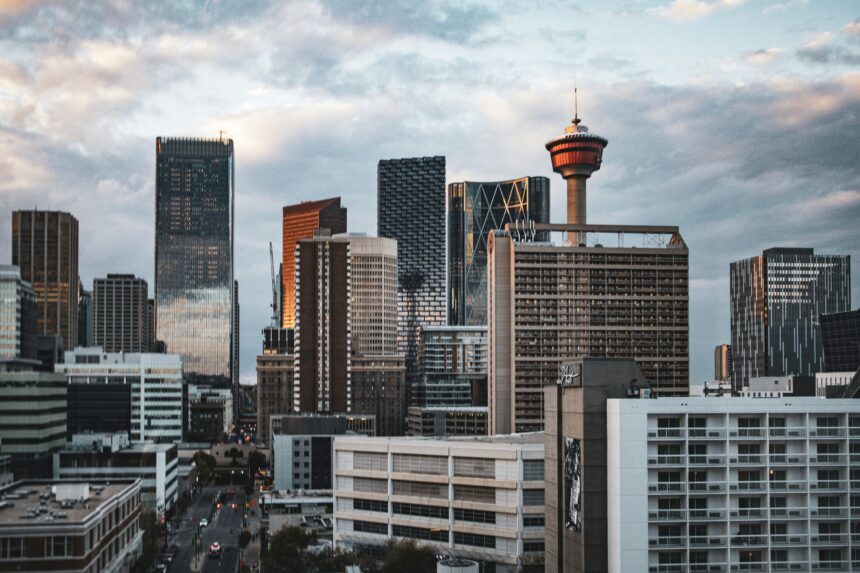
Calgary is building a $533 million water project that almost nobody will ever see. It runs under the northwest, it will not be finished until late 2029, and every new house north of the city depends on it.
Key facts
- Calgary’s northwest water project is priced at $533 million and is not expected to finish until late 2029.
- Ottawa has committed $29 million to the first construction phase, which is priced at $123 million, and the city funds the balance.
- The plan includes 22 kilometres of feeder main and 30 million litres a day of added capacity by early 2027.
- Once the full system is in service, it is expected to deliver up to 100 million litres a day.
- Reporting in July put the project at roughly $133 million above its initial budget.
Ottawa (Housing, Infrastructure and Communities Canada) has committed $29 million toward the first construction phase, which is priced at $123 million. The city funds the balance. That ratio is worth reading twice, because it is the ratio that shows up on a property tax bill.
What the money actually buys
The plan includes 22 kilometres of feeder main and an additional 30 million litres of daily capacity by early 2027. Once the full system is in service in late 2029 it is expected to deliver up to 100 million litres a day.
Those are not decorative numbers. Capacity of that size is what lets a growth corridor keep approving subdivisions. Water capacity is the constraint that sits underneath every housing supply conversation in this city, and it gets discussed the least because it is buried in a trench.
Calgary already learned what limited backup capacity costs. Repeated feeder main failures put the entire city on restrictions and turned a maintenance question into a civic emergency. Redundancy is unglamorous right up until the morning you do not have it.
The budget has already moved
Here is the part taxpayers are entitled to press on. Reporting in July put the project at roughly $133 million above its initial budget. That is not a rounding adjustment. That is a quarter of the current total added since the file was first approved.
Cost growth on buried infrastructure is not automatically scandal. Ground conditions surprise people, material prices move, and a project scoped in one interest rate environment gets delivered in another. Any honest observer allows for that.
What is not acceptable is an increase of that size arriving without a plain public explanation of which components moved and why. A city that can score 17,000 intersections with an algorithm is entirely capable of publishing a variance table on its largest water file.
Growth pays for growth, in theory
The standard municipal answer is that expansion infrastructure is funded through off site levies charged to new development, so existing ratepayers are not subsidizing the next subdivision.
In practice the line between growth capacity and system renewal blurs, especially on a project that also fixes a redundancy weakness the whole city felt. Some of this is expansion. Some of it is catching up on something that should have been built years ago. The public deserves to know the split, in dollars, not in principle.
That question connects directly to the one Calgary builders keep asking about approval timelines. Servicing capacity and permitting speed are the same bottleneck viewed from two ends. A permit means nothing if the pipe is not there, and a pipe means nothing if the approval takes half a year.
Three things worth publishing
A quarterly spend against budget, so residents can see the number move in real time rather than in a report a year later. A construction schedule with actual dates rather than target windows. And a plain statement of what share of the $533 million is funded by levies against what share falls to the tax base.
None of that slows the work down. All of it makes the next overrun easier to defend, because a city that has been transparent about the first $133 million gets more benefit of the doubt on the second.
Calgary needs this pipe. Calgarians paying for it need to be able to follow it.
Related from Alberta Tribune: Edmonton Wants Half Its New Housing Built Inside Existing Neighbourhoods