


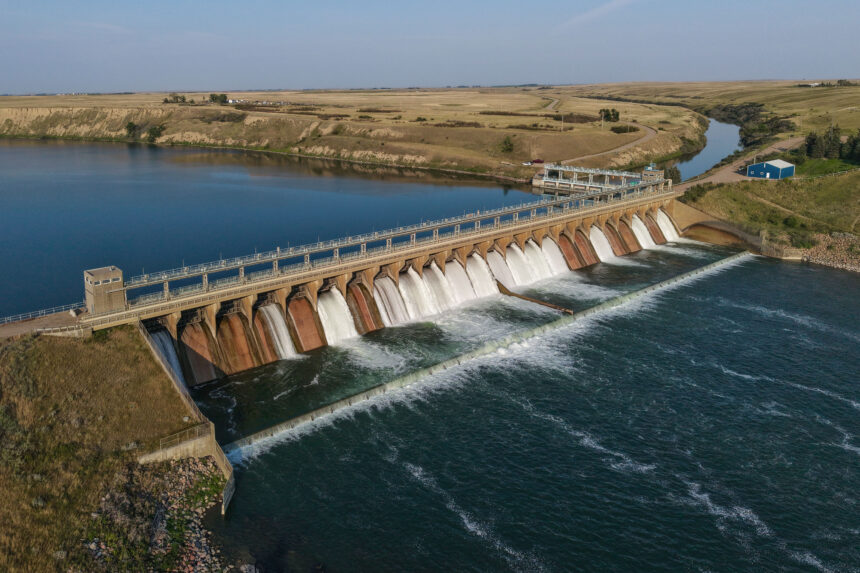
Key facts
- The Carseland-Bow River Headworks diverts Bow River water to the Bow River Irrigation District, watering about 119,000 hectares through its main canal.
- The headworks system is valued at approximately $1 billion and is described as critical infrastructure for southern Alberta. Alberta tender notice
- The original “Big Ditch” was a Southern Alberta Land Company project: an intake near Carseland raised the river 12 feet, and one excavation, “the big cut,” ran 64 feet deep and 1.75 miles long, moving some 1,500,000 cubic yards of earth.
- Circa 1912, the Southern Alberta Land Company held water grants on the Bow River near Carseland of up to 57 cubic metres per second.
1,500,000 cubic yards of earth. That was the size of a single cut in a single canal, dug to move Bow River water onto dry prairie. Southern Alberta’s farmland does not exist because the rain falls there. It exists because a ditch was dug, more than a century ago, and because somebody has kept the water moving through it ever since. Today’s water debates argue about allocation as though the delivery system were a fact of nature. It is not. It was built, by a land company, with picks, steam shovels and other people’s money, and the bill for keeping it has never stopped coming.
The water gets from river to farm through one headworks
The mechanism is straightforward and easy to take for granted, which is the problem. At Carseland, about 60 kilometres southeast of Calgary, a headworks system diverts water from the Bow River into a main canal serving the Bow River Irrigation District. The system waters about 119,000 hectares through that canal, and it also supplies municipalities, domestic users and livestock operations along the way. Headworks tender notice The province owns the headworks and contracts the irrigation district to operate and maintain it. The whole system is valued at approximately $1 billion. Same notice
None of this is natural. The Bow River would prefer to keep flowing to Saskatchewan, and in most years it does, after the canal takes its share. Every hectare watered is a hectare that exists as farmland because a diversion structure, a canal and a century of maintenance say so.
A land company dug the ditch, and the cut moved 1,500,000 cubic yards
The surviving account of the project reads like a prospectus written by men who had never been told no. Rancher J.D. McGregor concluded that the semi-arid land east of Calgary could grow far more than grass if it had water. He pitched British financiers, the Southern Alberta Land Company was formed, and the company bought 400,000 acres with irrigation in mind. Ronald Lane came in as president. Arthur Grace, the chief engineer, surveyed the ground and chose the intake: the Bow River near Carseland, by Johnson Island, where a combined earthen and concrete dam would raise the water the 12 feet needed to feed the canal. Project history
Then came the digging. The geography demanded what the builders called “the big cut”: an excavation 64 feet deep and 1.75 miles long to carry the water through the banks of the Bow River valley, requiring the removal of some 1,500,000 cubic yards of earth. Same account The bridge over the canal near the works took its name from the company’s president: Ronalane, for Ronald Lane. Corporate water grants of the era confirm the scale of the ambition; circa 1912, the Southern Alberta Land Company held Bow River grants near Carseland of up to 57 cubic metres per second. Alberta Agriculture water grant records
The promoters’ arithmetic is worth a look. At the time, it was said to take 35 acres of grassland to raise one steer. With irrigation, the plan was to invert the ratio entirely. Whether the numbers ever worked as advertised is a separate question. The ditch got dug, and the country it watered never went back to grass.
Keeping the water moving costs more than the debate admits
A $1 billion system does not maintain itself. Canals silt up. Structures age. The province has commissioned capacity assessments of the Carseland headworks aimed at increasing operational flexibility and water security during low-flow years on the Bow, while still meeting downstream licence obligations. Headworks tender notice In other words, the system built for the river of a century ago is being studied for the river of the coming decades, and the studying itself costs money before a single shovel turns.
This is the part of irrigation economics that rarely makes it into public argument. The water is often discussed as though it were free once allocated, a volume to be divided among users. But the water arrives through a structure that must be operated, repaired and eventually rebuilt, and those costs land on the public and the districts whether or not anyone mentions them at the podium.
The water debate is missing the ditch
The ditch is not a metaphor. Every position in Alberta’s water arguments, from farm groups to cities to environmental advocates, proceeds from the volume available to be divided. Almost none of it proceeds from the mechanism that makes the volume available in the first place. The canal is treated as scenery: a given, like the river itself.
It is not a given. It is a built thing with a builder, a maintainer and a bill, and it is now more than a century old. Forgetting the ditch means mispricing the water, because the price of the water was never just the licence fee. It was the 1,500,000 cubic yards of earth, the dam at Carseland, the hundred years of dredging and repair, and the next hundred years of the same. Argue about allocation all you like. Just remember that the thing being allocated only exists because somebody dug.
119,000 hectares. That is what the ditch waters, every season it runs.