
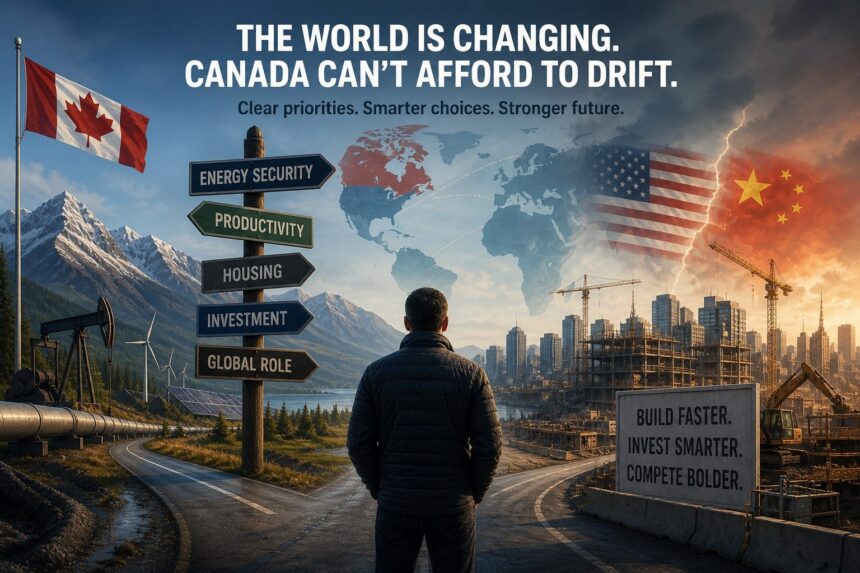
You don’t need to follow global politics closely to know something has changed. The world feels tighter than it used to. Less predictable. More competitive. For a long time, Canada operated in a relatively forgiving environment where trade was stable, major conflicts felt distant, and our proximity to the United States gave us a built-in advantage. We did not have to think too hard about where we fit or how competitive we really were. Things mostly worked. That is no longer the case.
The divide between the United States and China is not just political. It is economic, technological, and strategic, and it is reshaping how countries behave. Supply chains are being reworked, investment is shifting based on security as much as cost, and alliances are becoming more defined. Canada, whether we like it or not, is firmly aligned with the United States. That brings stability, but it also removes the option of drifting. We need to be clear about what we are good at and where we want to compete, because the world is organizing itself in a way that leaves less room for indecision.
Energy is the most obvious place where this shows up. In a more divided world, reliable energy is not just an economic asset, it is a strategic one. Countries want supply they can count on from partners they trust, and Canada should be at the front of that conversation. Instead, we have spent years making it difficult to build infrastructure, slow to approve projects, and inconsistent in how we approach our own resources. While other countries move projects forward, we continue to debate process. The result is not neutrality. The result is that investment goes elsewhere and opportunities that should have been ours are not.
That same pattern shows up when you look at productivity. Canada has been lagging for years, and it is starting to matter more. We take longer to build, we add layers of complexity, and we make it harder than it should be for capital to land and get to work. Other countries are moving faster. They are prioritizing infrastructure, streamlining approvals, and creating conditions where projects can actually get done. We are not keeping pace, and at some point that gap becomes harder to close.
Part of the problem is that Canada tends to avoid making clear trade-offs. We talk about growth, affordability, sustainability, and expanding services as if they can all move forward at the same time without friction. That approach becomes harder to sustain when the world becomes more competitive, because trade-offs are unavoidable. If we want more housing, we need to build faster and remove barriers. If we want more investment, we need to be competitive and predictable. If we want to play a meaningful role globally, we need to act with more clarity and consistency. Trying to do everything at once without prioritizing leads to slower progress on all fronts.
None of this is meant to be alarmist. Canada is still in a strong position. We have resources that the world needs, a skilled workforce, and stable institutions. Those are real advantages. But advantages only matter if you use them, and right now we are not using them as well as we could.
The next decade is likely to be more volatile. There will be more competition, more pressure on supply chains, and more moments where global events have direct consequences at home. In that kind of environment, being slow or unclear is not neutral; it is a disadvantage. Other countries are making decisions, moving projects forward, and capturing investment. The question is whether Canada intends to do the same, because the world is not waiting for us to figure it out.