

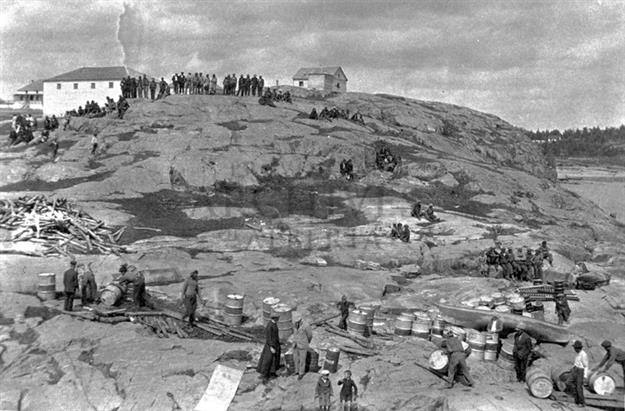
If you want the real founding moment of Alberta commerce, you do not look at the Legislature in Edmonton. You look at a rocky point on the south shore of Lake Athabasca where a North West Company trader named Roderick Mackenzie pulled up a canoe in 1788 and decided this was the spot. That decision built Fort Chipewyan. Within a few short years it was the richest trading post in North America.
Roderick Mackenzie picks a rock in 1788
The North West Company sent Mackenzie north on a calculated bet. Furs in the Athabasca country were thicker, finer, and more profitable than anything the company was getting out of the older posts further south. Mackenzie put the post at Old Fort Point because the lake fed it, the river system drained into it, and Indigenous trade networks already used the spot as a meeting place. Smart commercial geography. The same instinct that still drives Alberta site selection today.
How a private fur post became Alberta’s first commercial powerhouse
By the 1790s the period correspondence calls Fort Chipewyan the richest trading post on the continent. That is not Alberta Tribune talking. That is the company’s own factor records and the journals of visiting traders. The post collected pelts from a catchment that stretched from the Athabasca delta down to the Peace and out to Great Slave Lake. It paid its own way, funded its own expansion, and built a private trade economy in the absence of any colonial government within several thousand kilometres.
The two expeditions that started here
Two of the most consequential expeditions in Canadian history began at Fort Chipewyan.
- In 1789, Alexander Mackenzie left Fort Chipewyan and followed the river that now bears his name to the Arctic Ocean.
- In 1792, he left again, headed west, wintered at Fort Fork on the Peace, and in July 1793 became the first European to cross North America by land north of Mexico.
Both expeditions were funded and provisioned out of a privately operated fur post. There was no Crown grant. There was no expedition committee. There was a profitable business that wanted to know what was west of its own catchment.
What Old Fort Point looks like now
There is no reconstruction. There is no visitor centre on the original ground. What you can see at the south shore site are two large chimney piles, a cellar pit, four smaller pits, and a viewshed across Lake Athabasca that has barely changed in two and a half centuries. The site was designated a National Historic Site of Canada on May 16, 1930, and is listed on the Canadian Register of Historic Places under ID 17705. The modern community of Fort Chipewyan, which traces back to a later relocation of the post, sits across the lake on the north shore.
A heritage buff take on what Fort Chipewyan still says about Alberta
Here is the part most Albertans never get told. The oldest European-founded settlement in this province was not a Crown outpost. It was a private business. The first major Canadian exploration west of the Great Lakes was paid for by a fur trading partnership. The original Alberta commercial template is risk capital plus operator judgement plus a Indigenous trade network that already worked. Strip the dates off it and the same template still describes how big projects get done in this province. Operators read the country, take the risk, and build the thing that lasts.
That is a quietly radical idea for anyone who thinks Alberta got built by Ottawa. It did not. It got built at Fort Chipewyan in 1788, and the instinct that started it has been running ever since.
Listed on the registry. Fort Chipewyan appears on the Canadian Register of Historic Places as Site ID 17705 and was designated a National Historic Site of Canada on May 16, 1930.
Related reading from the series. Fort Fork and the 1793 continental crossing. Why Fort Chipewyan was rebuilt three times before it stuck.