

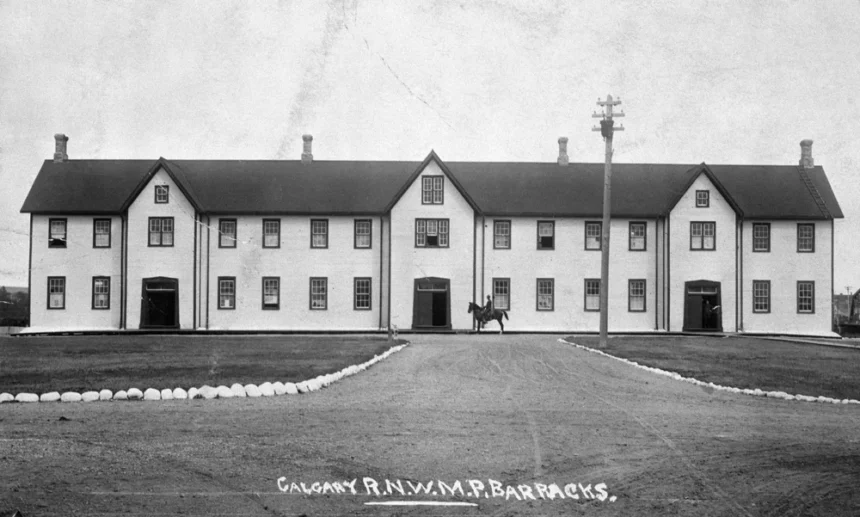
The city of Calgary started as a Mounted Police post on a triangle of land where the Bow River meets the Elbow. F Troop of the North-West Mounted Police rode in from Fort Macleod in August 1875 under Inspector Ephrem-Alphonse Brisebois with orders to establish a second NWMP post in southern Alberta. They built the post that fall. The original name was Fort Brisebois, after the commanding officer. That name lasted less than a year. By 1876 the post had been renamed Fort Calgary at the suggestion of Assistant Commissioner James F. Macleod, who picked the name after a family estate on the Isle of Mull in Scotland. The city around it has been called Calgary ever since.
The 1875 post and why F Troop was here
The mandate was simple. The NWMP needed a forward post north of Fort Macleod to extend law enforcement into the country between the Oldman and the Bow. The whisky trade was still operating in pockets, and the routes the American traders used ran through the Bow Valley. F Troop’s job was to interdict that trade, build a working relationship with the Blackfoot, Tsuut’ina, and Stoney Nakoda communities in the area, and establish a permanent base for the long winter.
The post was constructed on the high ground at the confluence of the rivers. The location had natural defensive value, easy water access from two rivers, and good visibility in three directions. It was a standard NWMP site selection, applied to the spot that would become downtown Calgary.
The renaming in 1876
The original Fort Brisebois name was a compliment to the troop’s commanding officer. The change to Fort Calgary in 1876 had at least three different stories attached to it depending on which source you consult. Macleod claimed the name came from his family estate on the Isle of Mull. Brisebois claimed he had been forced out and the name change was a snub. Other accounts suggest the change was a routine administrative decision to align with a pattern of place names already in use elsewhere. The likely answer is some combination of all three. The Calgary name stuck. Brisebois was reassigned within a year.
What the post looked like
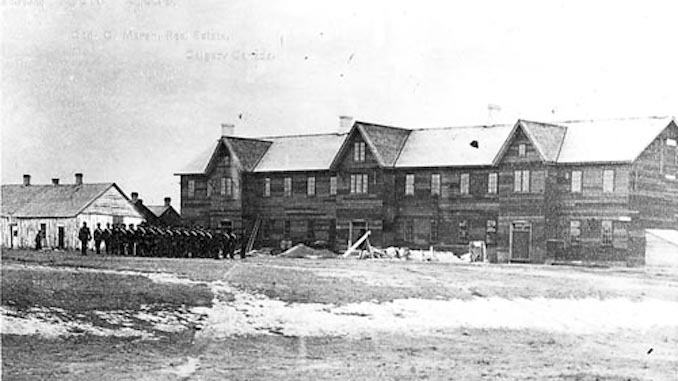
The 1875 post was modest by any standard.
- A rectangular wooden palisade enclosing barracks, a stable, a storehouse, and an officer’s quarters.
- A small parade ground in the centre.
- A flagstaff with the British and force colours.
- Pickets on rotation, especially during the first two winters.
The post was replaced and rebuilt several times over its operational life as Calgary grew up around it. By the time the railway arrived in 1883, the post was already being eclipsed by the commercial expansion of the surrounding town.
The town and the railway
The Canadian Pacific Railway crossed the Bow at Calgary in August 1883, and the town’s population began to climb almost immediately. The railway station was located west of the original fort site, which shifted the centre of commercial gravity. The NWMP post continued in reduced form for several more years before its functions were transferred to a larger post built nearby. Most of the original 1875 structures had disappeared by the early twentieth century, often demolished to make room for industrial development as Calgary’s commercial centre expanded along the rivers.
A modern interpretive centre operates on the original site as Fort Calgary, with reconstructed buildings, an extensive museum, and active archaeological work on the grounds. The site was designated a National Historic Site of Canada on May 15, 1925, and is listed on the Canadian Register under ID 12522.
A heritage buff opinion on the founding moment
Calgary is one of the few major Canadian cities founded explicitly by a police post. Most Canadian cities grew up around trade, ports, or rail junctions. Calgary started as a federal law enforcement decision. That origin story shapes the city in ways that are still visible. The street grid, the river orientation, the placement of the early commercial district, the historical relationship between the police and the rest of the local economy. All of it traces back to F Troop in 1875. Pre-railway Calgary was the size of a small village. Post-railway Calgary became the largest city between Winnipeg and Vancouver within thirty years. The NWMP made the spot legitimate. The railway made it grow. Both decisions still register in the modern city, and the original founding ground at the confluence of the Bow and Elbow is the place where the whole arc started.
Listed on the registry. Fort Calgary appears on the Canadian Register of Historic Places as Site ID 12522 and was designated a National Historic Site of Canada on May 15, 1925. The site is preserved and interpreted today at Fort Calgary at 9 Avenue and 6 Street SE.
Related reading from the series. Fort Macleod and the first NWMP outpost in southern Alberta. Fort Whoop-Up and the whisky trade that brought the Mounties to Alberta.