

Aaron Purchase, who runs an Edmonton company called MagnetaMR, says a hospital pays “between $1.5 million or $3 million just to buy a higher field conventional scanner,” and that his portable version lands at roughly 10% of that. For that number to reach a patient in Wainwright or Peace River, four things have to be true, and only one is about price. The machine has to work at a field strength the company has never published. It has to hold a Health Canada medical device licence. A health authority has to buy it. Somebody has to service it on a Tuesday in Grande Prairie.
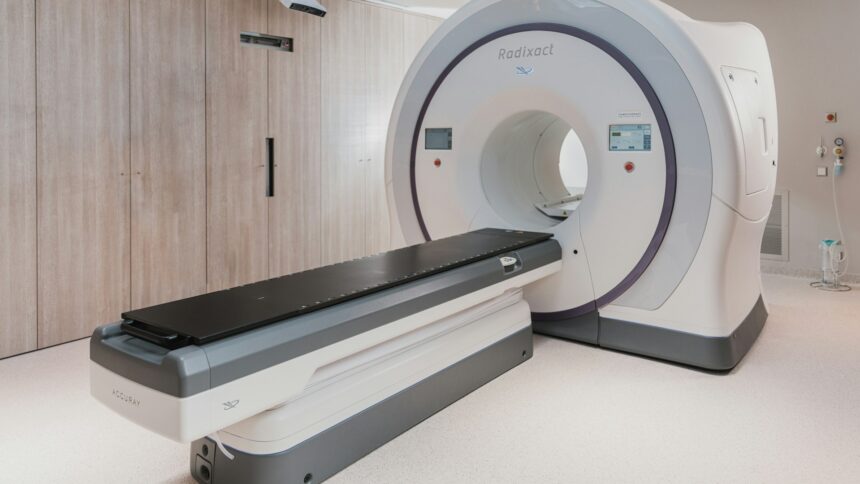
The case in favour is stronger than the doubters allow. Low-field magnetic resonance imaging, usually taken as roughly 0.25 to 1 tesla against the 1.5 to 3 tesla of a hospital scanner, is a real product category with paying customers. A weaker magnet needs less shielding and less structural steel under the floor, which is how MagnetaMR arrives at a unit of about 250 kilograms, given as 550 pounds in the reporting, small enough to wheel through a hospital door and plug into an ordinary outlet. That is a real engineering result.
Key facts
- MagnetaMR Inc. states on its own website in September 2026 that its portable low-field magnetic resonance imaging system carries a compact design of about 250 kilograms and is advancing through prototype development.
- Aaron Purchase, chief executive of MagnetaMR, said on 6 September 2026 that a conventional fixed-place scanner costs $1.5 million to $3 million and that the MagnetaMR system targets about 10% of that figure.
- The Alberta Cancer Foundation Breakthrough Fund expression of interest document for the autumn 2025 call sets each investment at $100,000, structured as equity alongside a lead investor or as a Simple Agreement for Future Equity carrying a 20% valuation discount.
- Health Canada requires Class II, Class III and Class IV medical devices to hold a medical device licence before sale in Canada, and requires Class III and Class IV devices to be designed and manufactured under ISO 13485.
- The Auditor General of Alberta reported in April 2021 that 70% of Priority 3 magnetic resonance imaging scans in Alberta exceeded the province’s 90 day target between April 2014 and March 2019.
What MagnetaMR has built so far
The company pitched at a DiscoveryLab event on 7 May 2025 seeking capital and users, and has assembled 3D-printed parts in a garage in south Edmonton. Its own website describes the system as advancing through prototype development, which is the honest phrase and the company deserves credit for using it. Aaron Purchase is chief executive and co-founder, Heather Purchase is the other co-founder, and Shawn Fraser came aboard in 2026 to run business development. A full prototype showing is planned for next month.
The detail that should sit at the centre of this story is an absence rather than a number. Nowhere on the company website, in its pitch listing or in its public statements has a field strength in tesla been published. Low-field covers a wide band, and the signal a scanner recovers scales roughly with the strength of its magnet, so a 0.5 tesla machine and a 0.05 tesla machine are different products serving different patients. One can look at a knee. The other mostly cannot.
The funding needs the same correction. The Alberta Cancer Foundation money gets described everywhere as a $100,000 grant, while the foundation’s own document for the autumn 2025 call describes the Breakthrough Fund as venture philanthropy that takes equity, either alongside a lead investor at the same price per share or through a Simple Agreement for Future Equity at a 20% valuation discount. A charity bought a position. That is a warmer signal than a grant, because somebody did diligence first.
Why the cost claim is the easy part
The nearest finished version of this idea is the Swoop system built by Hyperfine, and its paperwork is the best available schedule for what MagnetaMR faces. First clearance from the United States Food and Drug Administration arrived in February 2020. The Health Canada medical device licence, number 107054, followed in November 2021, roughly 21 months later by our count. The system is indicated for brain imaging and nothing else, and between February 2020 and December 2025 the company filed a dozen further clearances, most of them covering software and image quality rather than the magnet.
MagnetaMR is claiming whole body. Against a brain-only device that is a larger regulatory job, because every additional anatomy carries its own evidence burden. Health Canada licenses Class II, III and IV devices only after review, and Class III and IV devices must be designed and manufactured under a certified quality system. That is a factory discipline rather than a garage one, and the move between them is the step that kills most hardware companies. Nobody bolts a quality management system onto a finished prototype in a weekend.
Then comes the buyer, the part almost every cost announcement skips. A price of 10% of $1.5 million to $3 million puts the target between $150,000 and $300,000 by our arithmetic, which a rural health foundation could raise inside a year. Capital cost is rarely what stops a small hospital. Radiologist reading capacity stops it, service contracts stop it, and a field engineer who cannot reach Fort Vermilion inside two days stops it. A scanner nobody can fix becomes an expensive coat rack.
The wait time argument also deserves a harder foundation than it has been given. Lindsay Gilbert of the Alberta Cancer Foundation said waiting lists “can be months, sometimes years,” which is true and vague, and it has since been repeated as a firm figure it never was. The Auditor General of Alberta published the real numbers in April 2021. Between April 2014 and March 2019, 45% of urgent Priority 1 scans, 58% of Priority 2 scans and 70% of Priority 3 scans missed their targets. Those audited figures are now five years stale and nothing comparable has replaced them.
What Alberta should watch for by the end of 2027
If MagnetaMR publishes a field strength in tesla and confirms a filed Health Canada licence application by 31 December 2027, a licensed unit scanning patients in an Alberta community hospital before the end of 2030 is a fair expectation and the optimists will have been right. If the field strength is still missing after next month’s prototype showing, the two to three year commercialization estimate is a fundraising timeline wearing an engineering costume, and the right response is to wait for the number instead of the announcement.