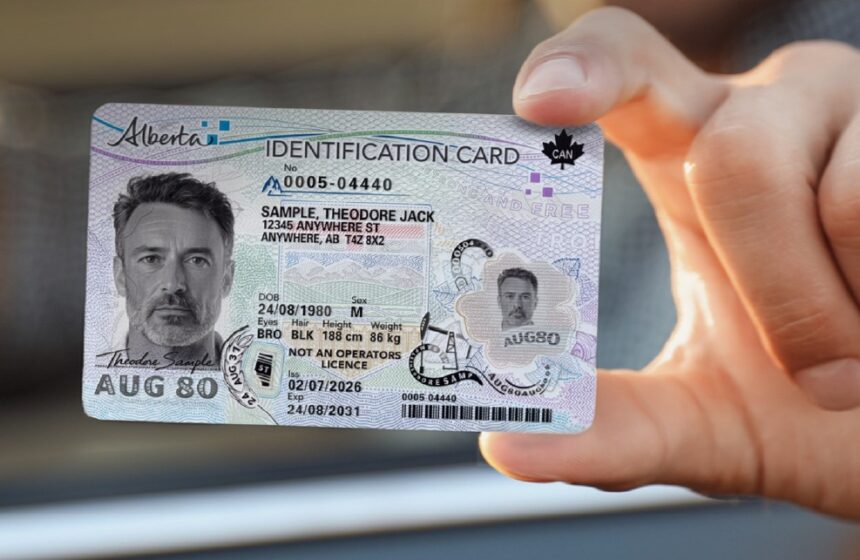
From July 2, new and renewed Alberta driver’s licences and provincial ID cards will carry a personal health number on the back and a small CAN marker in the corner for Canadian citizens. The card costs nothing extra. It sounds like a small administrative change, but one piece of plastic now does three jobs, and the rules around it matter more than the launch date.
Key facts
- Alberta driver’s licences and ID cards display the Personal Health Number for eligible Albertans starting July 2, 2026 (Government of Alberta).
- A Canadian citizenship marker appears on a card starting July 2, 2026, when the proof document provided confirms Canadian citizenship (Government of Alberta).
- Adding the health number or citizenship marker costs nothing extra during a regular application or renewal, though standard fees still apply (Government of Alberta).
- Non-citizens can still obtain an Alberta driver’s licence or ID card (Government of Alberta).
What the New Card Does
The province is folding three things into one document. The licence still proves you can drive. The health number on the back ties the card to the public system you already pay for. The CAN marker, printed in the top corner, indicates Canadian citizenship once it has been confirmed. At renewal, Albertans will be asked to show proof that they are legally entitled to be in the country, the kind of verification most people assume already happens and are surprised to learn did not.
Permanent residents and other non-citizens are not shut out. They can still hold a licence and an ID card. Their cards simply carry no citizenship marker. The change adds information for those entitled to it rather than removing access for anyone else.
The Case for Doing It
Fewer cards in the wallet is a genuine convenience, especially for older Albertans and anyone who has ever stood at a clinic counter hunting for a health card that vanished years ago. Tying identity, health coverage, and status to a single secure document also tightens the integrity of public services, which is a reasonable thing for a government to care about when those services are funded by the people using them. A province confident in how it runs its own programs should be able to confirm who is entitled to them without apology. This is the unglamorous, competent end of governance, the part that shows up as shorter lines rather than press conferences. It sits comfortably alongside other moves to run provincial systems on provincial terms, the same instinct behind Alberta defining its own symbols and standards.
The Concerns Worth Taking Seriously
Privacy advocates, including freedom of information groups, have flagged the obvious tension. Consolidating health, identity, and citizenship onto one card means more sensitive information rides on a single document that gets handed across counters, dropped in parking lots, and pulled out at traffic stops. A marker that signals citizenship status, even passively, invites questions about where and to whom that status becomes visible. None of this makes the policy wrong, and all of it makes the safeguards the part that matters most.
The value of the card depends on how it is run. Strong rules about who can scan it, what gets stored, and how the data is protected turn a sensible streamlining into a real upgrade. Weak rules turn it into an unannounced expansion of how much a single card reveals. Albertans are entitled to see the safeguards before the launch date.
This Reform Deserves a Close Watch
This is the kind of practical change that earns trust when it is done with care. It does not cost extra, it does not strip access from anyone, and it brings Alberta closer to the standard most people assume their identification already meets. The test is the discipline behind the idea, the same discipline taxpayers expect when governments handle money and information on their behalf.
Come July 2, the card will look almost the same. What it represents will be a little larger. Whether that is an improvement or an overreach depends on the rules written around it, so ask the province who can scan the card and what gets stored before the change takes effect.
Related from Alberta Tribune: Alberta Sends Energy Money Back to Families Starting July 1