
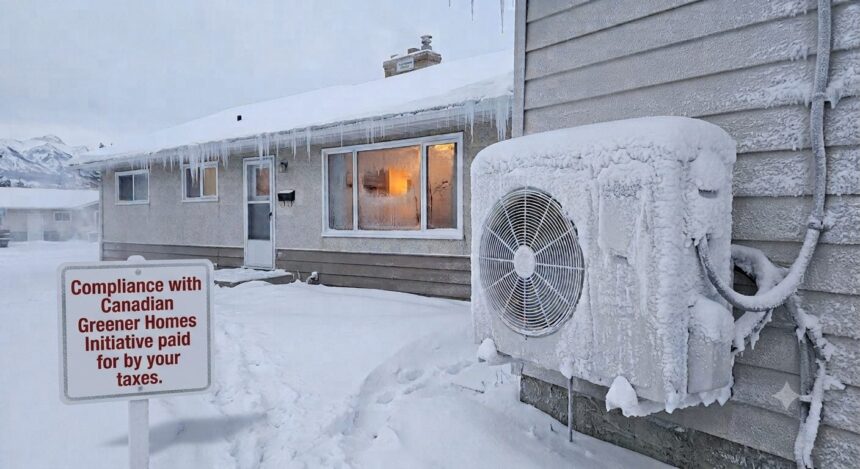
There is a massive chasm between the political fantasies concocted in Ottawa and the cold, hard realities of daily life in Canada. The federal government’s electricity strategy announced last month is a perfect example of this. It is a sweeping central planning scheme to double grid capacity, force EV adoption, and transition a million homes to electric heat pumps.
On the surface, they frame this as progress. But let’s call it what it really is. It is an expensive, heavy-handed mandate forcing technology onto Canadians that many simply do not want. To make matters worse, they are using billions of your own tax dollars to subsidize it, all while the rest of the world is quietly backing away from these exact same unworkable targets.
As we head into the summer of 2026, we need to talk about the sheer financial and practical absurdity of this plan, because it should concern every single taxpayer in this country.
Think about the fiscal sleight of hand going on here. The federal government loves to boast about free grants, rebates, and affordability programs for EVs and heat pumps. But we all know governments do not actually have their own money. Every single dollar funding these massive subsidies is extracted from your pocket.
Taxpayers are being forced to bankroll an economic restructuring they did not ask for. If electric vehicles and heat pumps were truly the superior, more affordable, and more reliable options for the average Canadian household, the market would adopt them naturally. You would not need a government bureaucracy to force the issue. Instead, Ottawa is using your hard-earned dollars to distort the market and manipulate your personal choices.
This blanket policy completely ignores Canadian geography. It is easy to champion electric heat pumps and EVs when you are sitting in a mild, dense urban center. It is an entirely different story when you are facing a gruelling winter where temperatures routinely plunge below minus thirty.
In extreme cold, standard electric heat pumps lose efficiency rapidly. To keep a home safe and warm during a real winter, you need a robust, reliable backup, which almost always means a natural gas furnace. Why are we subsidizing a massive shift to a system that requires a secondary backup just to keep the pipes from freezing?
The exact same logic applies to your garage. EV batteries can lose up to half their range during extreme cold snaps, and running the cabin heater drains them even faster. For anyone driving long distances or relying on a vehicle for heavy-duty work, an internal combustion engine is an absolute operational necessity, not a luxury. Pushing a massive reliance on an unproven grid during peak winter emand is a serious threat to basic reliability.
What makes this truly baffling is that while Ottawa doubles down on central planning, the rest of the world is waking up to reality. Across Europe and the United States, major automotive manufacturers are scaling back their aggressive EV targets because consumer demand just is not there. Governments overseas are quietly delaying or scrapping rigid bans on gas boilers and combustion engines because they have realized the infrastructure is not ready and the public cannot afford the bill.
Yet, Canada’s federal leadership seems determined to charge full speed ahead into a brick wall, completely isolated from global market trends and local infrastructure constraints.
Canadians are already facing a massive affordability crisis. The focus of any responsible government right now should be lowering the cost of living, reducing red tape, and ensuring the absolute reliability of core infrastructure like the power grid.
Instead, we are getting a strategy that tightens regulations, increases compliance costs for domestic energy producers, and pushes a forced transition. We do not need a government that picks winners and losers in the technology market, especially when the winners they choose struggle to operate in a Canadian winter. It is time to return to common sense, protect consumer choice, and stop using taxpayer dollars to fund unworkable political mandates.