

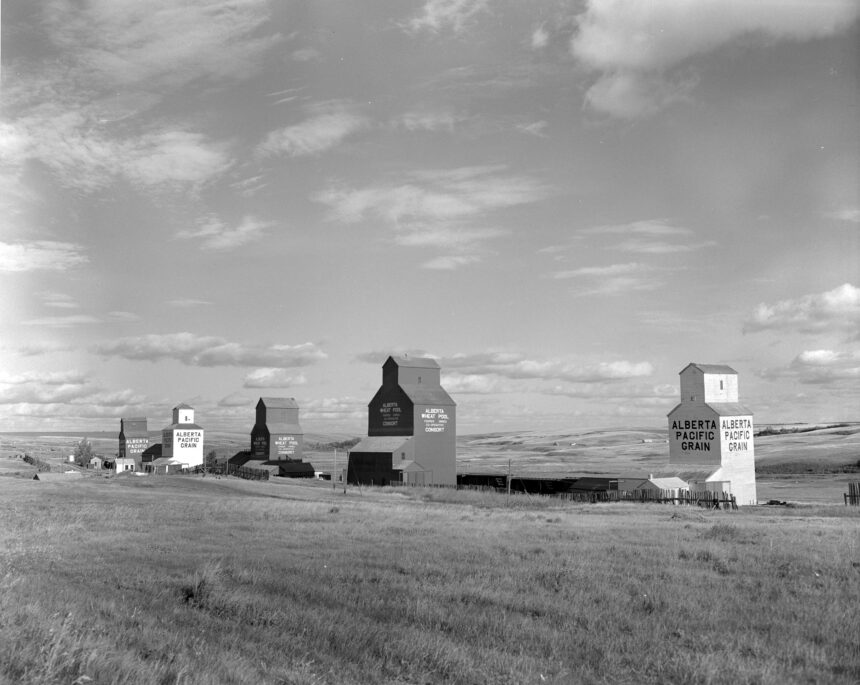
Drive almost any secondary highway in rural Alberta and you can still catch one out of the corner of your eye. A tall wooden box against the sky, paint gone chalky, the name of a town spelled out across the top in letters you can read from the road. For most of the last century these were the tallest things for miles, the first sign that a community existed at all. They are disappearing now, and most of us only notice when another one comes down and the horizon goes flat.
The scale of the loss is hard to picture until you see the numbers. At their peak in the 1930s the prairies held as many as 5,758 grain elevators. One stood roughly every 12 to 16 kilometres along the rail lines, because that was about as far as a farmer could haul a wagon of grain in a day and still get home for chores. Today fewer than 100 wooden country elevators survive across all three prairie provinces, somewhere around 6% of what once stood. The map below shows the Alberta sites that are still recorded as standing.
Surviving and recorded wooden grain elevator sites across Alberta. Tap any marker for the location. Points compiled from public heritage inventories and mapping projects. Some sites are restored landmarks, others are endangered or used for storage.
They were never just buildings
It is easy to file these under nostalgia and move on. That misses what they actually were. A country elevator was a piece of working engineering, a vertical warehouse that let a farmer turn a year of labour into a graded, weighed, paid-for commodity headed to market. It was also the economic heart of the town. The name painted on the side was a statement of fact and a little bit of pride. This place is real, it grows food, and it is open for business. When the railway and the elevator arrived, a town was born. When they left, the countdown started.
Why they came down
The honest story is not a simple tale of villains. Rail companies abandoned branch lines that no longer paid. The grain trade consolidated into a smaller number of huge concrete inland terminals that can load a hundred cars at once, which is genuinely more efficient than a wooden elevator built for horse-drawn wagons. Better roads and bigger trucks meant farmers could haul their own grain much further. Each of those changes made business sense on its own. The trouble is that the bill landed on the smallest communities, the ones that lost their rail stop, then their elevator, then their reason to keep a main street. Efficiency is real. So is what it costs the places left behind, a pattern rural Alberta knows from more than just the towns that emptied out around them.
What is left, and who is fighting for it
The survivors are still out there, mostly because someone local refused to let them fall. Alberta has designated 12 wooden grain elevators as Provincial Historic Resources, in communities like Andrew, Castor, Leduc, Meeting Creek, and Radway. The elevator at Raley dates to 1905 and is the oldest in the province. The one at Woodgrove, built in 1988, was the last wooden grain elevator ever raised in Alberta, which tells you the whole era opened and closed inside a single lifetime. Nanton turned its row into a discovery centre that draws visitors off the highway. Most of this work is done by volunteers, small-town museum societies, and families who grew up in the shadow of these buildings, not by some large agency with a budget to match.
A practical case, not a museum piece
This is where a clear-eyed Alberta view matters. Saving the last elevators is not about freezing the past or handing out heritage grants for their own sake. It is about keeping something that earns its place. These landmarks pull tourists into towns that need the traffic, they anchor local identity in a way no new build can fake, and they tell the true story of how this province fed itself and a good part of the world. The smart approach is the one Albertans usually prefer. Let communities lead, back them with modest and predictable support, use tax treatment that rewards restoration over demolition, and get out of the way of the people already doing the work. Like the other landmarks that define this place, the elevators are not making any more of these. Every one we tear down for scrap is a choice, and it is one we keep getting wrong.
Is a grain elevator just old lumber waiting for a match, or is it worth a little public effort to keep the last of them standing?