

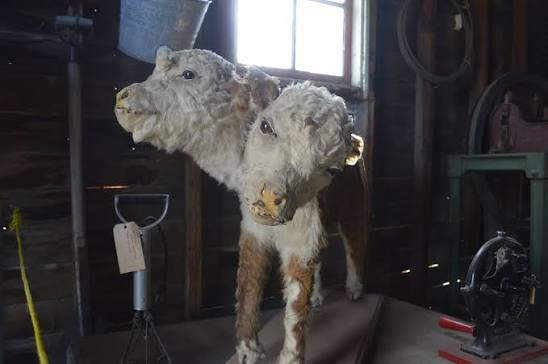
In December 1970, a two-headed calf was born on a farm near Beiseker and survived only a few hours. What happened next turned a sad barnyard moment into one of Alberta’s more unusual pieces of prairie history.
An amateur’s overnight work
Robert Isaac was an amateur taxidermist at the time, not a professional working out of a city shop. When the calf died, he took on the job of preserving it himself, working through a single night to keep both skulls intact and in their original position. Done badly, that kind of work falls apart within a few years. Isaac’s version held up for more than five decades.
From a farm shed to a museum floor
More than fifty years later, the calf remains one of the best-known exhibits at the Homestead Antique Museum in Drumheller, a collection built largely on the kind of everyday rural artifacts that rarely make it into big-city institutions. It sits alongside farm equipment, household tools and the ordinary material of prairie life, and it is consistently the piece visitors remember first.
The taxidermist comes back
Isaac recently returned to the museum to see his handiwork again, more than fifty years after that overnight job on a farm near Beiseker. Few amateur projects from a rural Alberta farmyard get a second look from their original maker half a century later, and fewer still are still standing in a public museum when that visit happens.
Why the strange stories stick
Alberta’s history is full of grain elevators, oil derricks and railway towns, and all of that deserves the attention it gets. But the strange, small stories, a farmyard oddity preserved overnight by a neighbour with no formal training, tend to be the ones that stick with people the longest. They are the pieces of prairie history that get passed down at kitchen tables long after the bigger headlines fade.
What is the strangest piece of local history sitting in a museum near you?