

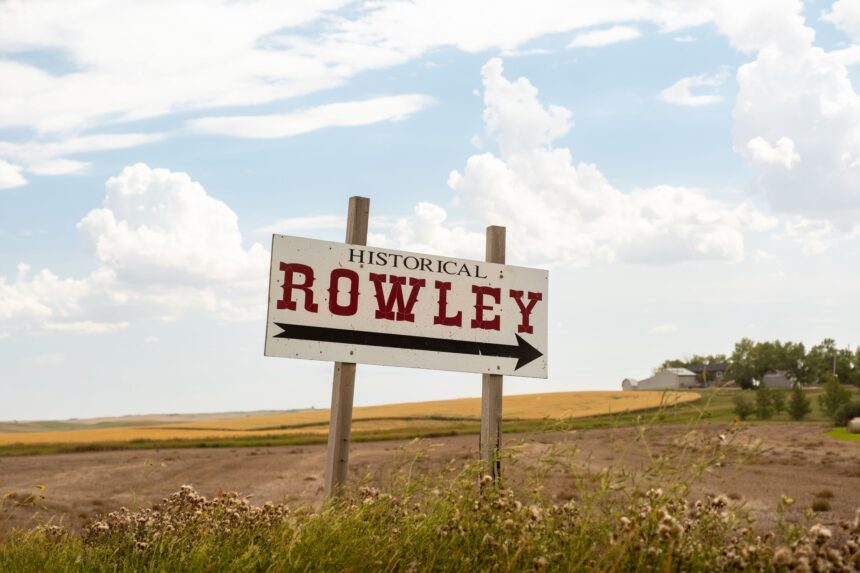
The Alberta Midland Railway pushed through the flat country north of Drumheller in 1911, and Rowley grew up along the tracks the way prairie towns did. Grain came in from surrounding homesteads, commerce followed, and by the 1920s the hamlet carried a population of roughly 500. A bank, a church, a school, and three grain elevators gave the place the bones of permanence.
Then the Depression came. Then the rail traffic thinned. Over the following decades, families packed up and the buildings went quiet one by one. By the mid-1970s, Rowley was a collection of hollow structures on a short stretch of unpaved road, home to a shrinking handful of diehards and not much else.
A Saloon and a Turning Point
The revival did not come from a government program or a heritage grant. It started, by most accounts, with a group of locals who broke into an old boarded-up saloon and threw a party. That impromptu gathering kicked off a conversation about what Rowley still had and what it might become. The community got to work. They restored the saloon, named it Sam’s Saloon after a respected local figure, and marked the occasion alongside Alberta’s 75th anniversary celebrations and a Rowley Homecoming in July 1980.
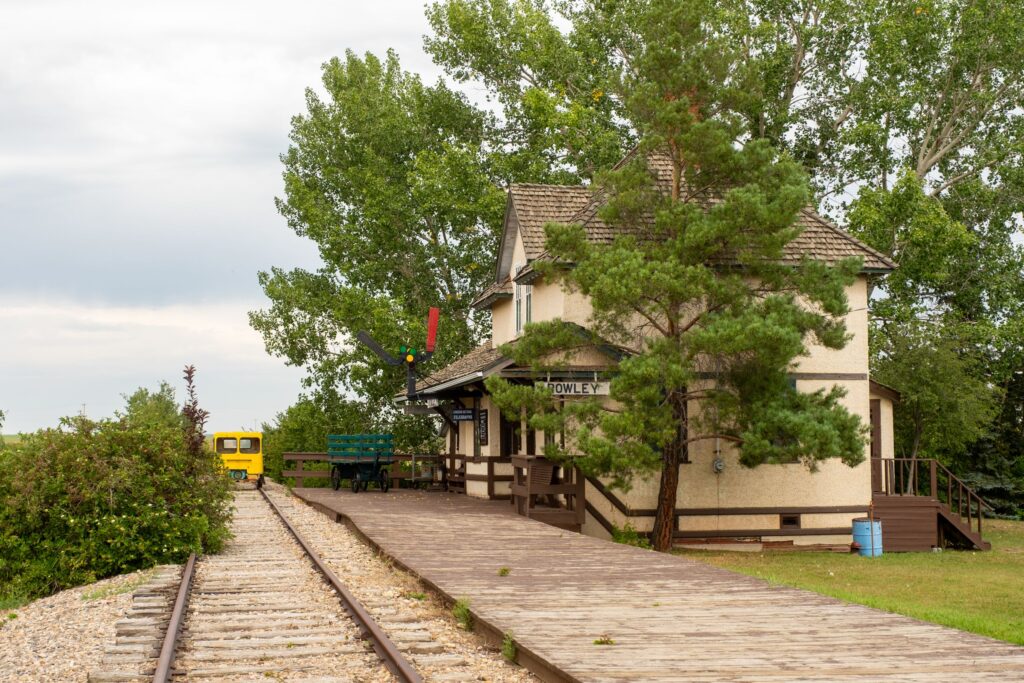
Over the next quarter century, residents took on the church, the bank, the train station, and the grain elevators. The work was slow and done on a shoestring, but it held. Three of the original elevators, first erected in 1915, still stand today and are designated Provincial Historic Resources. The Alberta government has formally recognized all three as examples of the wooden country elevator that once defined the prairie skyline. You can read more about the region’s industrial heritage around Drumheller.
Film Crews Took Notice
What the restoration produced was something film location scouts covet: an authentic main street that had not been touched by renovation trends or franchise signage. Director Anne Wheeler brought her production of Bye Bye Blues to Rowley in the summer of 1988. The 1989 film, set during the Second World War, needed the grain elevators, the station, and the old service station with its glass-reservoir gasoline pumps. The production designer built a funeral home across the street from the church specifically for the shoot. Rowley’s untouched character was the whole point.
Legends of the Fall, the 1994 Brad Pitt and Anthony Hopkins film, also used Rowley as one of its Alberta locations. The hamlet’s preserved streetscape and the surrounding badlands country made it a natural stand-in for early twentieth century rural life. Word got around, and a highway sign appeared at the turnoff. It reads, in large red letters: ROWLEYWOOD.
Pizza Nights and Staying Power
The permanent population today sits at fewer than twelve people, which makes Rowley’s ongoing vitality all the more striking. The community runs pizza nights on the last Saturday of each month at Sam’s Saloon, drawing visitors from across the province for wood-fired pies and live country music. The fundraiser has been running for roughly fifteen years and finances the ongoing maintenance of the restored buildings. It is, in a very practical sense, what keeps the lights on.
There are ghost towns across Alberta where the buildings eventually came down or simply fell. Rowley chose a different path. A handful of people decided the place was worth keeping, put in the hours, and somewhere along the way a dying hamlet acquired both a film credit and a nickname that outsiders find charming and locals have clearly earned.
Still Standing
Visitors who make the drive north from Drumheller find a main street that does not feel curated or staged. The elevators are weathered. The saloon looks its age. The church is small and plain in the way rural Alberta churches tend to be. None of it is pristine. All of it is real, which is harder to come by than it sounds.
Have you made the drive to Rowley, and what did you find when you got there?