
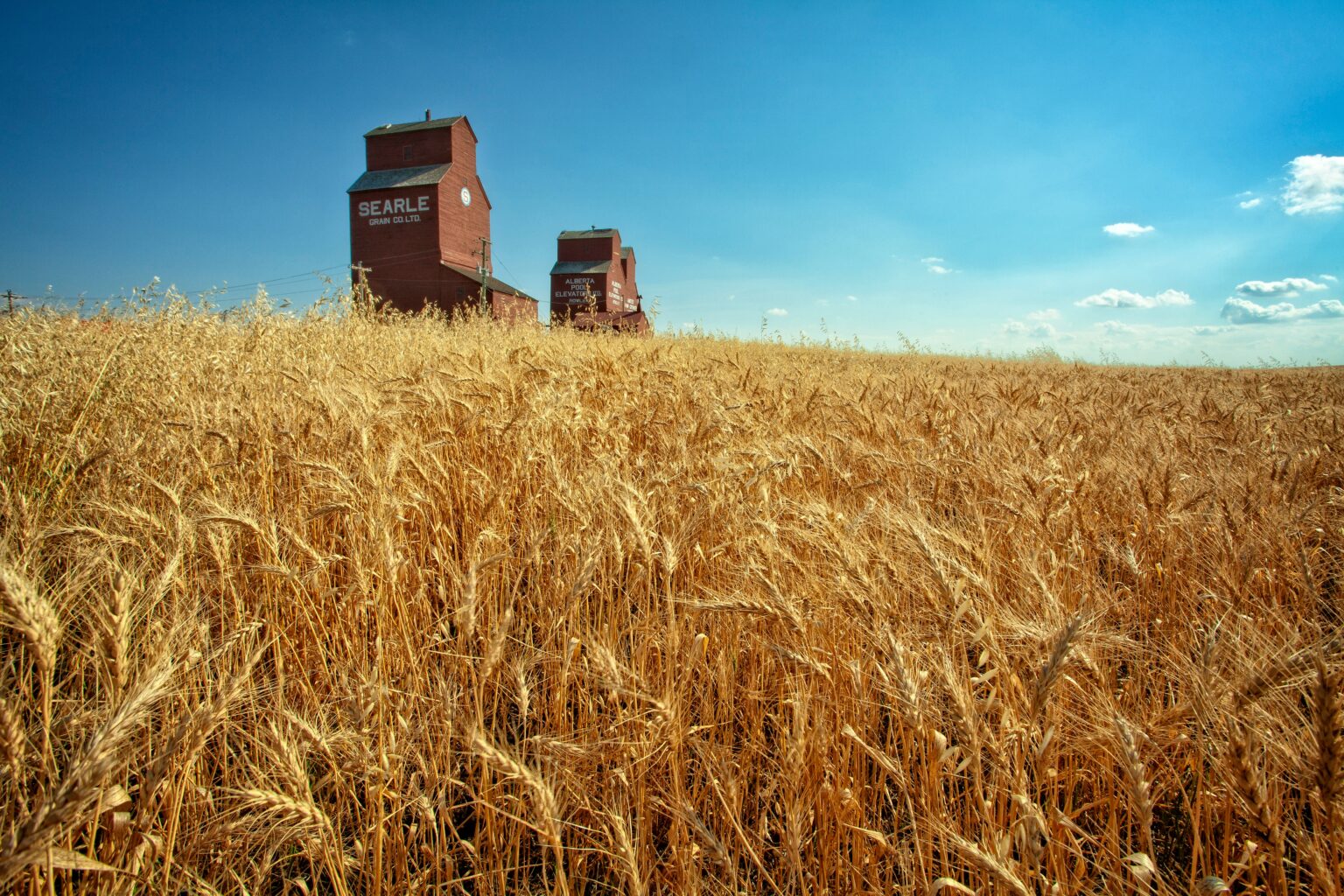

Alberta’s first wooden grain elevator went up in 1895. Within four decades, nearly 1,800 of them dotted the province. Across the three prairie provinces combined, the total peaked at 5,758 in 1933. From the road, in flat country, you could read the landscape by where they stood: a cluster on the horizon meant a town, a single tower meant a siding, a gap in the skyline meant you had passed the last one and were on your own for a while.
Fewer than 90 wooden grain elevators remain standing in Alberta today. That is not a rounding error. It represents a loss of more than 95% of what once defined the province’s agricultural geography.
What They Actually Were
The elevator was a working machine, not a monument. Farmers drove grain wagons, then trucks, to the nearest elevator to weigh, grade, and store their crop before it moved by rail to the terminals. The structure had to be close enough to be practical, which is why they appeared in almost every hamlet with a rail line. In good years the lineups stretched down the road. The elevator agent knew every farmer by name, knew their land, knew whether a late shipment meant trouble at home or just a slow harvest.
The wooden construction was specific to the task. Cribbed timber walls, vertical grain filling the gaps, created a structure strong enough to hold thousands of bushels and simple enough that rural builders could put one up without specialized equipment. The builders also, whether they intended it or not, produced something that read as a landmark for miles. Writers and photographers took to calling them prairie sentinels, and the name stuck because it was accurate. They marked territory in both a practical and a symbolic sense.
Why They Disappeared
The decline was not sudden. It ran across several decades and had multiple causes. Road transport replaced rail as the primary way grain moved short distances. Trucks could reach a larger facility on a paved highway faster than a wagon could reach the local elevator, which meant the local elevator stopped making sense. Grain companies responded by consolidating into fewer, larger facilities.
Through the 1990s, the industry shifted hard toward high-throughput concrete terminals. A modern inland terminal can handle close to 50,000 tonnes and load a 52-car freight train in a single day. The math was straightforward for anyone running a grain company. For the hamlet that had organized itself around the local elevator, the math led somewhere else entirely.
Fire took some. Demolition took more. A wooden structure left without maintenance goes quickly, and many communities lacked the resources or the numbers to mount a fight. Alberta’s rural infrastructure shrank in many forms through this period, and the grain elevator was simply the most visible casualty.
What Preservation Looks Like Now
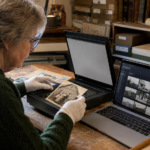
Some communities have found ways to hold on. Nanton, south of Calgary, has surviving elevators that received heritage designation, and a University of Calgary project used 3D scanning to create detailed digital records of the structures, a form of preservation that acknowledges the buildings may not survive indefinitely in wood and nail. Rowley, north of Drumheller, has three elevators designated as Provincial Historic Resources, funded in part through the community’s monthly pizza nights and heritage tourism in the region. The Alberta government has formally recognized a small number of wooden elevators across the province as historic resources, in communities including Andrew, Castor, Leduc, Meeting Creek, and Scandia.
A dozen designated survivors out of nearly 1,800 is a thin margin. The rest are photographs, memories, and the occasional empty lot on a main street where you can still see where the foundation sat.
What the Loss Measured
There is a practical argument for preserving these buildings, rooted in tourism and heritage education. There is also something harder to quantify. The grain elevator was the physical centre of a local grain economy that required people in proximity: farmers, elevator agents, railway workers, and the businesses that served all of them. When the elevator closed, the economic logic that held a community together often closed with it. The building going down was sometimes the cause, sometimes the symptom, and usually both at once.
Alberta built its agricultural identity around these structures and the communities they anchored. The ones still standing are worth the drive.
Is there a grain elevator in your part of Alberta that deserves recognition before it is gone?