

Long before Highway 2 carried traffic across southern Alberta, freight moved north the slow way, by wagon, on a route with no pavement and no bridges, called the Old Macleod Trail.
Two Days By Bull Train
From roughly 1870 through 1885, bull trains made the run between Fort Macleod and the settlement that would become Calgary every summer. A single train could mean 130 oxen pulling 30 wagons loaded with supplies, moving at the pace of an animal that does not hurry for anyone. It took a team roughly two days to haul a load from one end of the route to the other, and the wagons kept running through the 1870s and 1880s, before a railway ever reached Fort Macleod.
The trail connected with the Whoop-Up Trail and the larger trade corridor stretching south to Fort Benton, Montana, tying the earliest freight economy of southern Alberta to a supply chain that started well below the border. It was a working road built for a working purpose, hauling everything a settlement needed to survive a prairie winter. Flour, tools, whisky, dry goods, mail, all of it moved north the same way, at oxen speed, over ground with no engineering behind it beyond the ruts the last wagon train had already cut.
There was no romance in the job while it was happening. A bull train driver spent two days exposed to prairie weather, managing a team of animals that could bog a wagon axle-deep in a spring mudhole without warning. The romance came later, decades after the last bull train made the run, once the trail itself had become something worth remembering rather than something to be endured.
A Trail That Outlasted Its Own Wagons
Once the railway reached Fort Macleod, the bull trains stopped running and the trail itself started disappearing under grass, under roads, under a growing city. That could have been the end of the story. Guy Weadick, one of the founders of the Calgary Stampede, thought otherwise. Before his death in 1950 he planted the idea of marking the route so it would not vanish from memory the way it had started vanishing from the map.
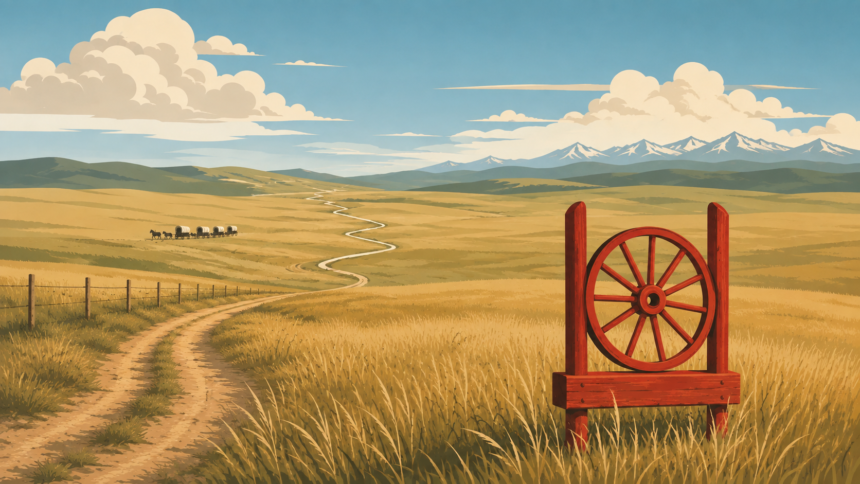
The idea sat for three decades before it moved. Volunteers picked it up in the 1980s and began placing distinctive red and black wagon wheel markers along the corridor from Fort Macleod north toward Calgary. Local organizer Bill Dunn spearheaded the project through the 1990s, turning a founder’s idea into a physical trail of markers a person could actually follow. None of it was fast, and none of it was funded the way a modern heritage project might be. It was farmers, ranchers and local historians agreeing a piece of the province’s working history deserved a marker, then finding the time and the materials to plant one, one post at a time, over years rather than months.
The Last Marker Went Up In 2023
The project finished on its own long timeline. In July 2023, the Old Macleod Trail Marker Posse installed the 21st and final sign in Calgary’s Ramsay neighbourhood, completing a set of markers that had taken more than 40 years to place from the first wheel to the last. Some stretches of the original route still carry visible wagon-wheel ruts in the ground, a detail the Museum of the Highwood has documented as part of the trail’s surviving physical record.
A route that once connected to Willow Creek and the wider network of stopping points across southern Alberta now exists mostly as those 21 markers and the memory kept by the people who worked for decades to place them.
What A Wagon Wheel On A Post Actually Marks
It would be easy to drive Highway 2 or Macleod Trail through Calgary today and never notice one of the wheel markers, let alone know what they mean. That is exactly the gap Weadick’s idea and the volunteers who finished it were trying to close. A modern highway sits on top of a route that predates the automobile, the railway, and in some stretches the province itself.
Southern Alberta’s story is full of infrastructure that came and went, trails abandoned for rail lines, rail lines abandoned for highways. What is unusual about the Old Macleod Trail is that somebody decided the disappearing version deserved a marker anyway, and then a small group of volunteers spent four decades making sure it got one. A road can vanish from the map and still leave its mark on the province that grew up around it.
Have you ever spotted one of the 21 Old Macleod Trail wagon wheel markers between Fort Macleod and Calgary?