

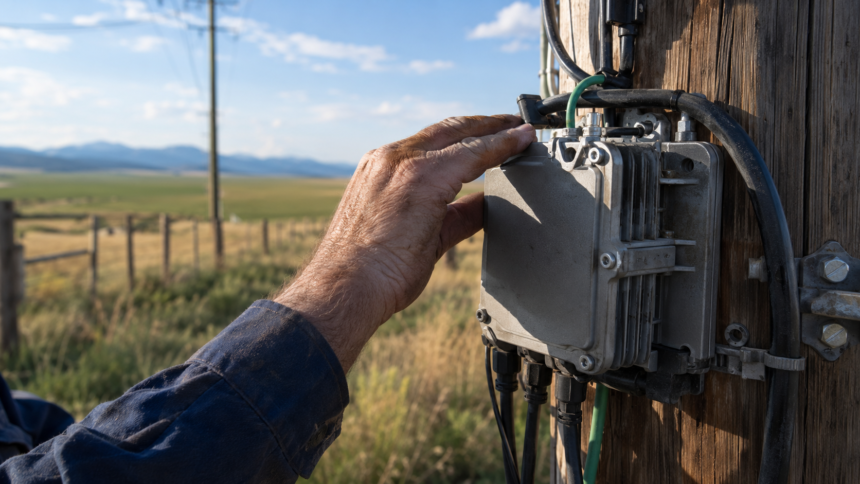
When Alberta extended reliable power into rural communities, the decision was not purely commercial. It rested on a belief that rural Alberta was foundational to the provincial economy, not peripheral to it. We are at an analogous moment with AI and compute infrastructure.
Beyond two downtowns
The most valuable version of Alberta’s AI future is distributed across the whole province. Concentrating everything in Calgary and Edmonton would capture a fraction of the opportunity. A coordinated network keeps both the economic value and the governance under Alberta control, closer to where the work actually happens.
A tiered compute network
Picture three tiers. Hyperscale and enterprise-grade compute in the urban core of Calgary and Edmonton, handling primary development, training, and large model inference. Regional nodes in Red Deer, Lethbridge, and Grande Prairie, anchored to grid infrastructure and serving industrial and municipal applications with lower latency. And modular, containerized edge compute in places like Peace River, Brooks, and Pincher Creek, putting low-latency capacity next to agriculture, energy field operations, and remote industrial sites.
Rural Alberta is not the periphery of this province. It is the foundation of it, and an AI strategy worth building treats it that way.
Why rural Alberta is the foundation
The agriculture, energy production, and natural resource industries that generate the wealth funding Alberta’s public services are overwhelmingly located outside the major cities. A grain operation running precision agriculture needs systems that process local data in real time, under local governance, without depending on a latency-sensitive link to a distant cloud. Building for that reality is how the whole province shares in the advantage.
The coordination question
Alberta’s grid, energy abundance, transmission infrastructure, and deregulated market create an environment most regions cannot match. The skilled trades and engineering capability are present in depth. What remains is coordination: the policy alignment, capital formation, and institutional commitment to turn individual assets into a coherent strategy. The resource is here. The question, as in 1947, is what we build around it.
Frequently asked questions
What is the distributed AI province idea?
It is a vision for spreading AI compute across Alberta in tiers, from urban hyperscale centres to regional nodes to rural edge compute, so value and governance stay across the whole province rather than two cities.
Why does rural Alberta need local AI compute?
Operations like precision agriculture and energy field work need to process data locally in real time, under local governance, without depending on distant cloud infrastructure that adds latency and risk.
What is a micro data centre?
A small, often modular and containerized compute facility placed close to where data is generated, providing low-latency AI capacity for regional and rural operations.
This piece is part of the Alberta Tribune series on applied AI in Alberta. See also Alberta’s Energy Is the Launchpad for AI Infrastructure and Where AI Pays Off Across Alberta’s Industries.
ZAK is the founder of AIwithZak.com and CEO of ORKA AI. He writes on provincial AI strategy and policy at AI Alberta, and works with leadership teams across Alberta and Western Canada on applied AI strategy and execution.
Should Alberta’s AI future be concentrated in two cities, or built across the whole province?