

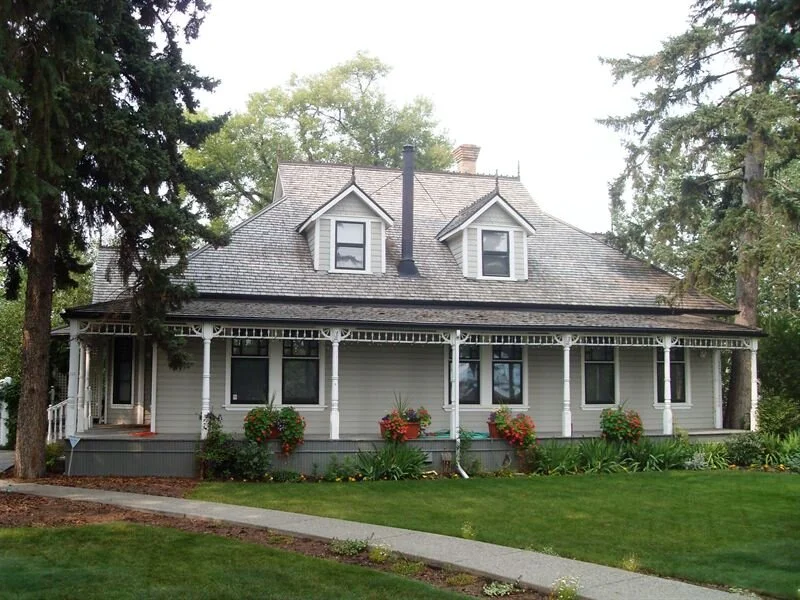
Calgary’s east side does not look like a heritage neighbourhood until you start counting the survivors. The Major John Stewart House on New Street SE in Inglewood is one of the oldest residences still standing in the city. Built in 1885 from a design by Calgary architect Robert Moberly, it predates the railway boom that reshaped downtown and the sandstone wave that built Stephen Avenue.
Who Major John Stewart was
Stewart arrived in Calgary in the early 1880s with a background in the Mounted Police and a small accumulation of capital from earlier postings. He invested in town lots in Inglewood when Inglewood was still the working centre of Calgary, before the railway shifted the commercial gravity north toward 9 Avenue. He built the house in 1885 for his family.
The residence is a two storey wood frame structure with a deep front porch, scroll-cut bargeboard, and the kind of vertical proportions that mark the late Victorian residential style. Moberly designed it with the kind of modest formality that worked for a respectable middle-class household of the era.
Why Inglewood matters
- Inglewood was the original commercial centre of Calgary, anchored on Fort Calgary and the Bow River crossing.
- The railway in 1883 ran north of the original townsite, which slowly pulled commercial energy away from Inglewood toward 9 Avenue.
- The residential character of Inglewood was preserved by accident more than by design. The commercial boom moved north, and the old neighbourhood was bypassed rather than redeveloped.
The Stewart House is one of a small cluster of pre-1900 residences that survived in Inglewood because the neighbourhood was not torn down for downtown expansion.
What the building tells you about pre-sandstone Calgary
Most of what survives from 1880s Calgary downtown is sandstone commercial architecture from Stephen Avenue. Residences from the same period almost all went under the wrecker through the twentieth century. The Stewart House survived for the same reason the Hunt House did. It was in a part of town that did not get aggressively redeveloped.
The residence was given Provincial Historic Resource designation on November 29, 1977, and is listed on the Canadian Register of Historic Places as Site ID 5141.
A heritage buff opinion on the residence
The reason this building matters is the timing. 1885 is the year before the great Stephen Avenue fire. It is two years after the railway crossed the Bow. The population of Calgary was somewhere between five hundred and a thousand people, depending on which census you consult. A wood frame residence built that year, by a local architect, for a working pioneer family, is one of the only surviving physical artefacts of what Calgary actually looked like as a small town before the boom.
Most heritage discussion in Calgary focuses on the big sandstone monuments. The Stewart House is the small residential side of the same story. A working family put up a respectable house, the family that came after them kept it intact, and a handful of neighbourhood preservationists pushed for the formal designation in the 1970s. That sequence is how heritage actually gets saved in a city that is otherwise indifferent to its own past.
Worth a slow walk through Inglewood if you are interested in what Calgary looked like before the sandstone wave. You can see the bones of an earlier town if you know where to look.
Related reading from the series. The Hunt House and the oldest building still standing in downtown Calgary. Stephen Avenue and how Calgary built its sandstone spine.