

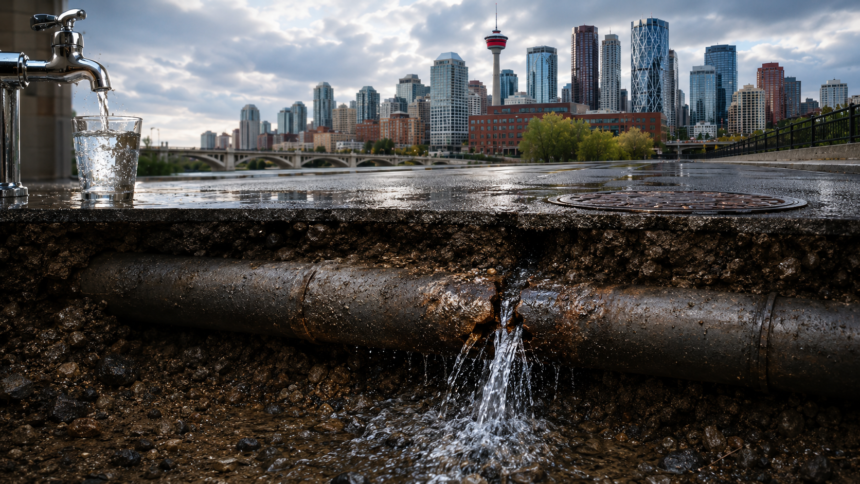
Turn on a tap in Calgary and you are paying for water twice. Once for the litre that reaches your kettle, and once for the litre that never arrives, the one that slipped through a cracked main somewhere beneath the street and soaked quietly into the gravel.
Calgary’s own published figures put 2025 system water loss at 23%. Nearly a quarter of the treated, tested, pressurized drinking water produced by this city disappeared underground before it reached a single customer. In daily terms, that is roughly 120 million litres. Picture 48 Olympic swimming pools drained into the dirt, every day, all year.
The Utility Bill Nobody Itemizes
Water loss is not a new problem in Calgary. The rate has bounced between 20 and 24% since 2019, which means this has been the operating normal for the better part of a decade. Edmonton, two hundred kilometres up the QE2 with colder winters and older neighbourhoods, loses about 8%. Calgary’s gravelly, porous soil makes leaks harder to spot, and that is a real engineering challenge. It is not a three-times-worse-than-Edmonton excuse.
Every one of those lost litres was treated to drinking standard. Chemicals, filtration, testing, pumping, staff. Ratepayers funded the full industrial process, and then the product leaked away before delivery. No private business could survive losing 23% of its finished inventory in transit. A monopoly utility can, because the customer has nowhere else to go and the loss is invisible until somebody publishes a report.
A $342 Million Ask Deserves a Scoreboard
City administration is now proposing $342 million over the next four years to accelerate leak detection, replace aging mains and expand metering. The stated goal has losses falling to 15% before 2030 closes. Pipe replacement is supposed to climb from 7.8 kilometres last year to 10 kilometres in 2026, then 15 kilometres annually from 2027.
Fixing pipes is exactly what a city should spend money on. Core infrastructure ahead of decorative priorities, basics ahead of branding exercises. If council moves this through, it will be one of the more defensible line items in the budget.
But Calgarians have earned the right to attach conditions. This is the same city hall that found itself rationing outdoor water use in 2024 while a catastrophic main failure was patched, and the same one that watched fees and charges pile onto household budgets while core systems quietly aged. A 15% target in 2030 is a promise about the future from an institution that let the present get to 23.
What Accountability Should Look Like
Three things would make this program credible. First, public reporting, annually at minimum, of the actual loss percentage, in plain language, not buried in a utility appendix. Second, hard interim targets. If the plan is 15% by 2030, then name the number for 2027 and 2028 and report against it. Third, a clear accounting of what happens to the money if targets are missed. Programs that cannot fail tend not to succeed.
None of that is radical. It is how any Alberta business owner would treat a contractor quoting a third of a billion dollars. The city is asking ratepayers to fund the repair of a system those same ratepayers already funded once. The least it owes them is a scoreboard.
The Bigger Alberta Lesson
There is a provincial moral here too. Alberta’s cities are growing faster than almost anywhere in the country, and growth gets used to justify every new tower, event district and downtown vision document. The unglamorous truth is that growth runs on mains, valves and pumps. A city that loses a quarter of its drinking water underground has not earned the right to lecture anyone about sustainability, and a province attracting hundreds of thousands of newcomers cannot afford municipal systems that quietly waste what families are billed for.
Calgary has the plan and the wealth to fix this. What it needs now is the discipline to treat water like what it is, a product Calgarians have already paid for, twice.
Should council tie the $342 million to hard public targets, or trust the process? Tell us what you think.
Frequently Asked Questions
About 23% of treated water was lost to leaks before reaching customers. The city’s loss rate has stayed in the range of roughly 20% to 24% since 2019.
The city’s Accelerated Water Loss Program aims to cut losses to 15% by 2030, supported by a recommended $342 million over four years for water-main replacement, expanded leak detection, and advanced metering.
Aging mains combined with gravelly, porous soil make leaks harder to detect. The city plans to increase annual pipe replacement, targeting about 15 kilometres a year from 2027 onward.