

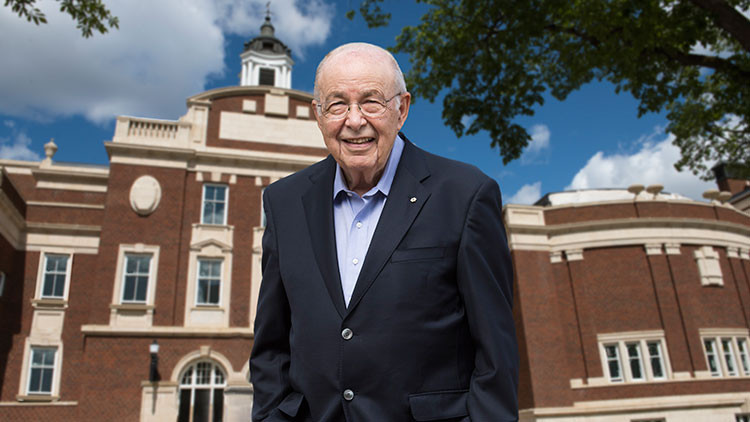
Dr. Cyril Kay has spent more than sixty years studying the molecules that build living things, and just as long building the teams and institutions that made that research possible in Alberta. In 2021, the Government of Alberta inducted Kay into the Alberta Order of Excellence, recognizing a scientific career that helped make the University of Alberta’s biochemistry department one of the strongest in the country.
A Calgary Childhood Marked by Loss and a Scholarship
Cyril Max Kay was born on October 3, 1931, in Calgary, to parents who had immigrated a decade earlier from what is now Belarus. His father sold produce at Calgary’s old City Hall market to support the family, and when Cyril was 12, his father died. His mother took over the market stall, and with money tight, a university education seemed out of reach until a family friend suggested he apply for McGill University’s new J.W. McConnell scholarship, covering tuition, room and board for four years. Kay was awarded one of only four such scholarships in 1949.
From St. John’s, Quebec, to Cambridge
Kay had wanted to study honours chemistry, but with McGill short on space after an influx of veterans following the Second World War, the program’s first two years were based in St. John’s, Quebec, roughly 70 kilometres from Montreal. He instead chose honours biochemistry, which kept him in Montreal, a decision that changed the direction of his life and introduced him to professors who nurtured a lasting fascination with proteins and enzymes. He met Faye Bloomenthal while home for a summer break, and she later joined him in Boston while he pursued his doctorate at Harvard. The couple married in 1953, and a postdoctoral stint at Cambridge University sparked Kay’s enduring interest in muscle proteins.
Building Canada’s First Protein Research Group
In 1958, the University of Alberta recruited Kay to its Department of Biochemistry, one of only two such academic positions open in Canada at the time. With colleague Dr. Larry Smillie, he was asked by the Canadian government to co-lead the country’s first Medical Research Council Group on Protein Structure and Function, recruiting complementary experts from across North America. Between 1974 and 1995, the group published more than 1,600 peer-reviewed papers and trained 250 students and postdoctoral fellows, helping establish the University of Alberta’s biochemistry department as one of the country’s leading programs. In 1990, Kay became a founding member of the Protein Engineering Network of Centres of Excellence, a scientific alliance of roughly 60 researchers across Canada, and chaired its Scientific Advisory Board through its 15 years as one of the country’s top life sciences networks.
A Career That Never Really Slowed
Kay retired as Professor of Biochemistry in 1995 after 37 years at the University of Alberta, but by 1998 the Alberta Science and Research Authority had recruited him to help build the province’s health research plan, including a study of how to grow Alberta’s research and development capacity in energy, information technology and life sciences. In 1999 he became Vice President of Research for the Alberta Cancer Board, spending a decade growing cancer research cooperation across the province, work that ended when the province wound down the Cancer Board in 2008. Kay then helped guide a foundation established by Dianne and Irving Kipnes toward building the Alberta Lymphedema Network, drawing researchers from multiple disciplines into a field that had received little prior study. Honoured as a Fellow of the Royal Society of Canada and a Member, later Officer, of the Order of Canada, Kay has published 349 research papers and continues to serve on the Scientific Advisory Board of the Oncopole cancer research centre in Toulouse, France. He and wife Faye have two children, Lisa and Lewis, a biophysicist in his own right, and four grandchildren.
How does a boy who once helped sell produce at a Calgary market end up training 250 scientists across six decades? Ask Cyril Kay, and he will likely credit the team before he credits himself.