


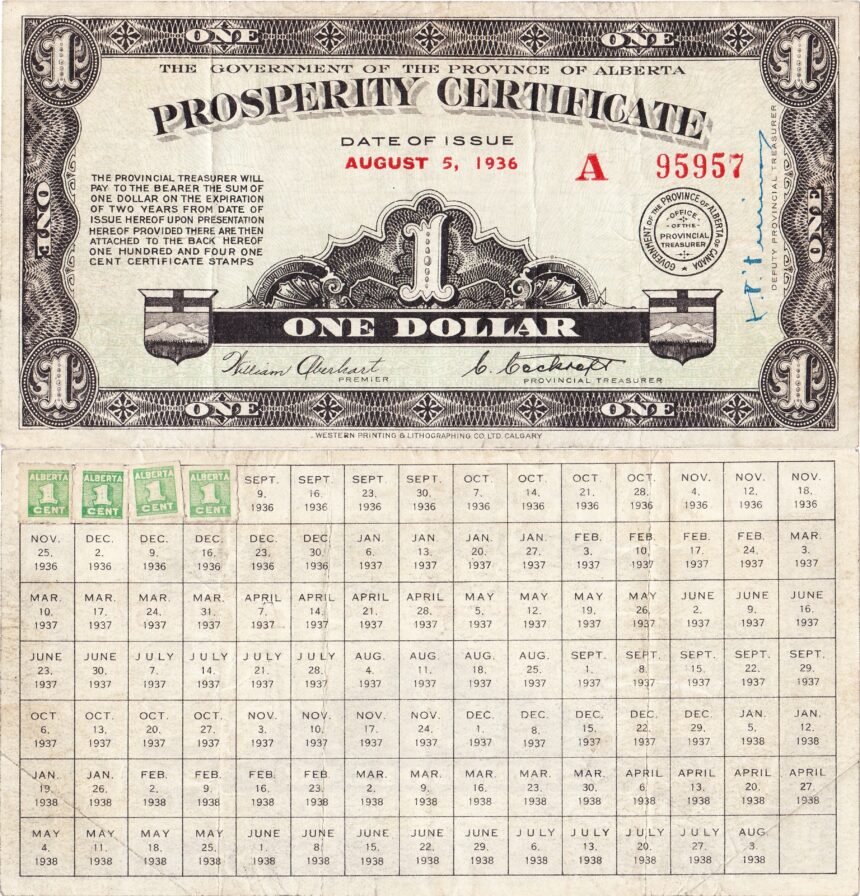
Ninety years ago this month, Alberta paid some of its workers in money that came with an expiry date built right into the paper. Not printed on it exactly, but taped to it, one small stamp at a time, week after week, or the dollar in your pocket quietly stopped being worth a dollar.
A Dollar That Needed Feeding
In August 1936, Alberta’s provincial government began issuing what it called prosperity certificates, marked at one dollar, to men working relief jobs on provincial road crews. The certificates looked like currency and spent like currency, with one catch built into the design. To keep a certificate valid, the holder had to buy a one cent stamp every week and stick it to the back of the note.
There was room on each certificate for 104 stamps, which meant two full years of weekly stamp purchases to keep a single dollar alive and spendable. Miss too many weeks and the certificate lost its value, a strange kind of currency that punished the person who tried to save it rather than the person who spent it.
The Idea Behind the Stamps
The thinking wasn’t unique to Alberta. Stamp scrip, sometimes called demurrage currency, had been circulating as an idea through Depression-era economics discussions well before 1936, built on the theory that money loses its point if people hoard it. Force a small weekly cost onto holding the note and people spend it instead of sitting on it, and money that moves puts someone else to work down the line.
It made for an awkward jurisdictional fight almost immediately. Ottawa treated currency issuance as federal turf, and a provincial government printing its own dollar equivalents, stamps or not, drew exactly the kind of friction you’d expect from a constitutional grey area nobody had bothered to test before.
Merchants Weren’t Convinced
The program never grew into much. Only around $239,000 worth of certificates ever entered circulation, a modest sum even by 1936 standards, and more than 60% of that total had already been redeemed or returned within the first year. Merchants didn’t fully trust a note that came with fine print about stamps and expiry, and workers who’d already earned a dollar the hard way on a road crew weren’t eager to keep spending pennies just to keep that dollar technically alive.
The gap between the theory and the storefront turned out to be the whole story. On paper, a self-liquidating currency that forced spending sounded like a clever fix for a stalled economy. At the till, it was one more thing a shopkeeper had to explain to a customer who just wanted change for a loaf of bread.
What’s Left of Them
The certificates didn’t last long enough to become a habit, let alone a fixture of Alberta life, and most Albertans today have never heard the phrase “prosperity certificate” at all. What survives are a handful of the notes themselves, tucked into collections and the occasional local museum case, each one a small paper record of a two year experiment in making money spend itself.
Picture the actual object for a second. A certificate was printed to look like ordinary currency, roughly the size of a regular banknote, with a grid of small boxes on the back where each week’s stamp had to go. A road crew worker carrying one around for months would have watched that grid fill in gradually, a visible ledger of how long the dollar had been circulating instead of sitting untouched in a drawer.
The provincial government wasn’t hiding what it was trying to do. The whole design was meant to nudge behaviour, discourage hoarding, and get a fixed amount of relief spending moving through small-town economies faster than a regular payday would. Whether it actually worked at that scale is hard to say from the numbers alone, since the certificates never circulated widely enough to test the theory at any real size.
Alberta wasn’t first to try the idea and wasn’t the last. Similar stamp scrip schemes surfaced in small towns across North America during the same stretch of the Depression, most with the same short lifespan and the same basic problem, a public that trusted paper money right up until someone attached conditions to it.
It’s worth picturing the mechanics of it for a second, a road crew worker in 1936 pulling out a dollar certificate at the general store, glancing at the row of stamps already stuck to the back, doing quick math on how many weeks were left before the next one was due. Ninety years later, that dollar, stamps and all, reads less like a failed policy than a strange little artifact of just how hard the Depression pushed governments to try almost anything.