


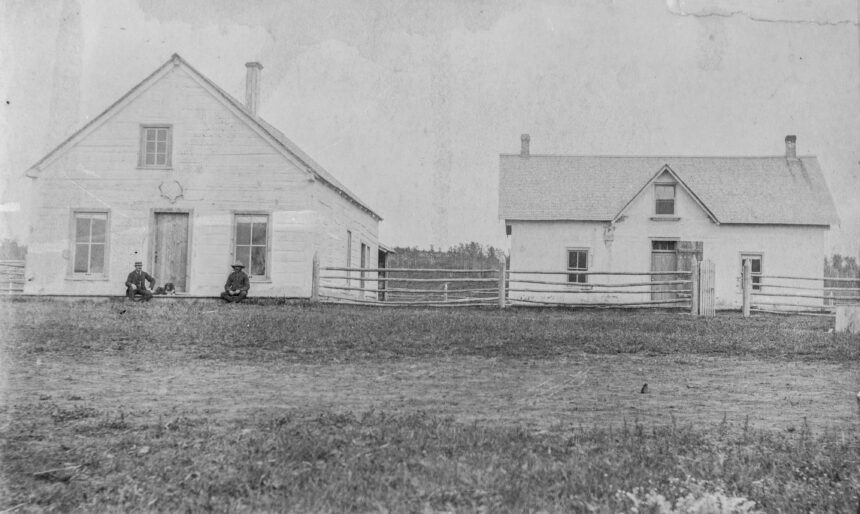
Most Alberta heritage sites tell one story. Victoria District tells four at once. Methodist missionary George McDougall established the Victoria Methodist Mission on the north bank of the North Saskatchewan in 1862. The Hudson’s Bay Company opened its own Victoria Trading Post on the same ground in 1864. Cree communities were already in the area. A Métis settlement built up alongside the mission and the trading post within a few years. By the late 1860s, you had four overlapping populations on the same bend of the river, sharing the same gardens, the same firewood, and the same winter. That density of overlap is unusual in early Alberta, and it makes the site one of the most layered pieces of heritage real estate in the province.
A Methodist missionary picks the site
George McDougall arrived in the western interior in 1860 to take charge of the Methodist mission work in the Hudson’s Bay Company territories. He picked the Victoria site in 1862 for the same kinds of reasons every other site in this country gets picked. Reliable water, productive soil for a mission garden, a position that put the mission within reasonable horseback distance of Fort Edmonton, and proximity to Cree camps that travelled through the area on seasonal rounds. McDougall’s son John McDougall arrived to assist, and the Victoria Mission became the working hub for Methodist outreach across the central Alberta parkland for the next decade.
The Hudson’s Bay Company shows up
In 1864 the HBC opened Victoria Trading Post on the same bend of the river, within easy walking distance of the mission. This is the part most people skip when they tell the story. The fur company set up beside the church because the church had picked the right site first. The HBC was not in the business of evangelism. It was in the business of trade. If McDougall had brought together a stable mission population in a productive part of the country, the HBC wanted a counter on the ground to handle the commerce.
Four communities on one bend
By 1870 the Victoria Settlement included:
- The Methodist mission church, parsonage, and school under the McDougalls.
- The Hudson’s Bay Company trade post and warehouse.
- A growing Cree settlement that used the mission gardens during the summer rounds.
- A Métis hivernant community that wintered in the area in the years when the buffalo hunt brought them east.
That is four distinct communities sharing one piece of ground. The arrangement was not always smooth. It was, however, functional, and it lasted for the better part of three decades.
Pakan and the long quiet century
After the HBC consolidated its operations and the buffalo hunt ended, the Victoria Settlement gradually shifted to a quieter Métis and Cree farming community. The settlement became known as Pakan, named for the Cree leader who lived in the area. The HBC operations shut down. The mission infrastructure persisted as a small church and a community building. Active populations dropped through the twentieth century. The site today is preserved as the Victoria Settlement Provincial Historic Site, administered by Alberta Parks, with several restored historic structures.
Victoria District was designated a National Historic Site of Canada on October 17, 2001. It is listed on the Canadian Register of Historic Places under ID 7744.
What a four-culture site teaches a heritage reader
The buff opinion is that Alberta’s earliest layered communities deserve more attention than they get. The standard heritage story is too clean. One fort, one mission, one period of significance, one preserved building. Real Alberta history has always been messier and more interesting. Victoria District is the example most people have never heard of. Four cultures, one bend in the river, three working decades. If you want a piece of the province that explains how the early communities actually functioned, you drive out to Pakan and walk the grounds. The river is the same river. Most of the rest is gone. The arrangement is still legible if you look for it.
Listed on the registry. Victoria District appears on the Canadian Register of Historic Places as Site ID 7744 and was designated a National Historic Site of Canada on October 17, 2001. The site is administered today as the Victoria Settlement Provincial Historic Site.
Related reading from the series. Rundle’s Mission and Alberta’s first Protestant inland outpost. Father Lacombe Chapel, the oldest standing building in Alberta.