

It is a subtle kind of news, the sort that makes no one stop walking, and it deserves rather more attention than it will receive. South Korea is removing its 3% import tariff on Canadian crude oil. Canadian crude, in any honest accounting, means Alberta crude. A nation on the far side of the Pacific has decided to make this province’s chief export cheaper to buy, and it did so of its own accord.
What was actually signed
The tariff decision was announced in April 2026, set within a broader and warming relationship between Canada and South Korea that reaches as far as defence procurement. Alongside it, the Government of Alberta and Hanwha Energy signed a memorandum of understanding spanning energy development, industrial expansion and supply-chain infrastructure. The near term is crude. The stated next chapter widens into hydrogen, ammonia-based energy carriers and carbon management. Hanwha’s shipbuilding arm, separately, has been bidding into Canada’s next-generation submarine program. This is a relationship being constructed across several files at once, with the patience that real relationships require.
The modest virtue of 3%
3% sounds like a rounding error to anyone who has never had to sell a barrel.
The margin lives at the edge
Heavy crude trades on narrow spreads, and a refiner compares delivered cost with the cold attention of a man balancing his own books. A 3% penalty at the border is quite enough to send him toward a competing barrel. Remove it, and the Alberta barrel becomes the better proposition on price before a single argument has been made on its behalf. Small numbers, in this trade, settle large contracts.
Access is not the same as welcome
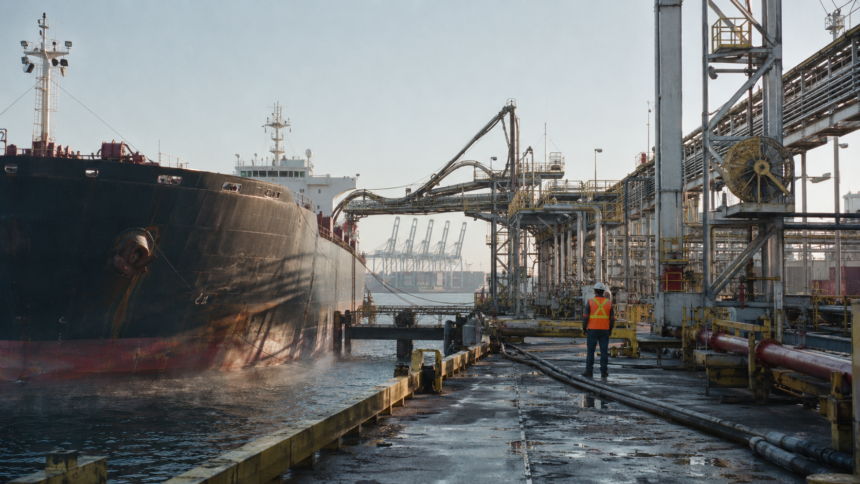
Tidewater gave Alberta the means to reach the buyers of Asia. The tariff’s removal improves the terms on which it reaches them. Access without competitive terms is a pipe pointed at a market that still has every reason to choose another supplier. The two together are what convert a route on a map into a customer who returns.
The argument the realists were mocked for making
For the better part of a decade, the men and women who argued for new pipelines and new markets were instructed that they were chasing a dwindling thing. Wind it down, they were told. Wind it down. What is unfolding with South Korea is the precise scenario those realists described and were patronised for describing. Alberta crude moving to Asia. Asian capital and industry moving toward Alberta. A market no longer dependent on a single buyer for very nearly every barrel it ships. That was no luck. It is the overdue dividend of an argument made unfashionably, and made anyway.
It is worth stating the scale plainly. The economies of Korea and Japan are not a courtesy market to be thanked for its polite interest. They are among the largest crude importers on earth, and they are presently looking for supply that does not travel through a single unsettled region. Alberta is one of a small number of jurisdictions able to answer with both volume and stability. To be the obvious second call in a nervous market is a strong and enviable place to stand.
The exposure of the single customer
For most of its modern history, Alberta sold the overwhelming share of its exported crude to one country. Any merchant who has ever depended on a single account understands the danger folded into that sentence. One buyer sets the price. One buyer governs the relationship. One buyer revises the terms whenever its own politics happen to turn. A second serious customer does more than add a column of volume. It restores the thing a province in that position most lacks, which is the freedom to say no.
What an Albertan should watch for next
Candour requires a caution. A memorandum of understanding is a statement of intent and not a finished work, and the hydrogen and carbon-management chapters remain early. Yet the direction is unmistakable. The demand from Asia is real, the tariff wall is coming down, and Trans Mountain already runs near full. The next pipeline would open the same door wider still. A province with two strong buyers negotiates from confidence. A province with one negotiates from hope, and Alberta has done quite enough negotiating from hope.
South Korea lowered the tariff because it wants a supplier it can rely upon, and Alberta is positioned to be exactly that. That is the ordinary shape of a healthy trading relationship. The province should treat it as the standard it intends to meet again, and not as a happy exception.