
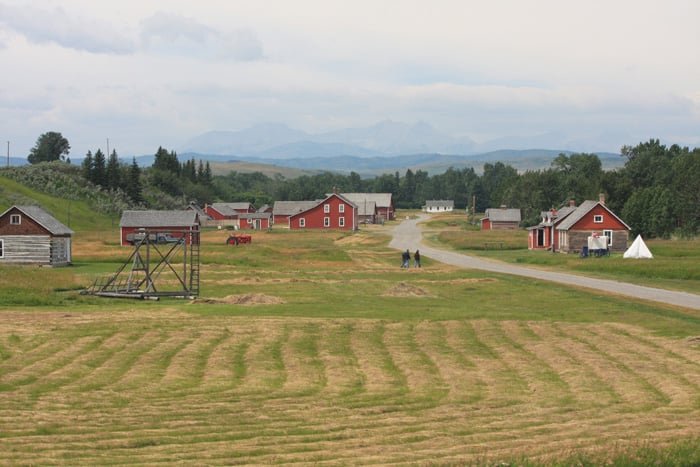

Drive an hour south of Calgary and the foothills open onto Pekisko Creek country, Rockies wind combing the fescue across the valley where Alberta ranching grew up. The operation that became the Bar U started in 1882 under the corporate name North West Cattle Company, though everyday speech preferred the herd’s brand, a U sitting beneath a bar.
At its height the operation ran across more than 150,000 acres of foothills. Three remarkable stewards ran it in turn. Fred Stimson built the foundation, George Lane gave it scale, and Pat Burns folded it into his business empire, while its herds and its purebred Percherons pulled buyers across an ocean. For seven decades, until 1950, few ranching outfits anywhere in the country matched its standing.
The Winter That Sorted the West
The test came in the winter of 1906-07, the killing season that old-timers spoke about for the rest of their lives. Snow crusted over the grass, chinooks failed to arrive, and across the prairies the great open-range outfits lost herds wholesale. That winter broke most of the big companies and ended the open-range era on this side of the line. The Bar U held when others folded, carried through by superior land, shrewder management and the stubbornness this country teaches.
Names that shaped the province passed through the valley. George Lane co-founded the Calgary Stampede as one of the Big Four. Burns built a meat-packing empire that fed the country. Even the Sundance Kid drew Bar U wages for a stretch, breaking horses before his career change. The ranch was an economy, a finishing school and a legend factory all at once.
The Only One of Its Kind
Canada keeps exactly one national historic site for its ranching industry, and it sits off Highway 22 near Longview. Walking the site means moving through an exceptional concentration of original ranch buildings, cookhouse to blacksmith shop to saddle horse barn, the work still legible in every beam. It is like the province’s other founding sites, less a museum than a deed of title for a culture.
Alberta’s ranching story is sometimes told as romance. The Bar U corrects that. It was a business, capitalized seriously, managed shrewdly, exposed to weather and markets, and it endured because competence and care for the land ran together. The brand meant responsibility, and the valley still holds everyone who carries one to it.
Have you walked the Bar U grounds? Tell us what stayed with you.