


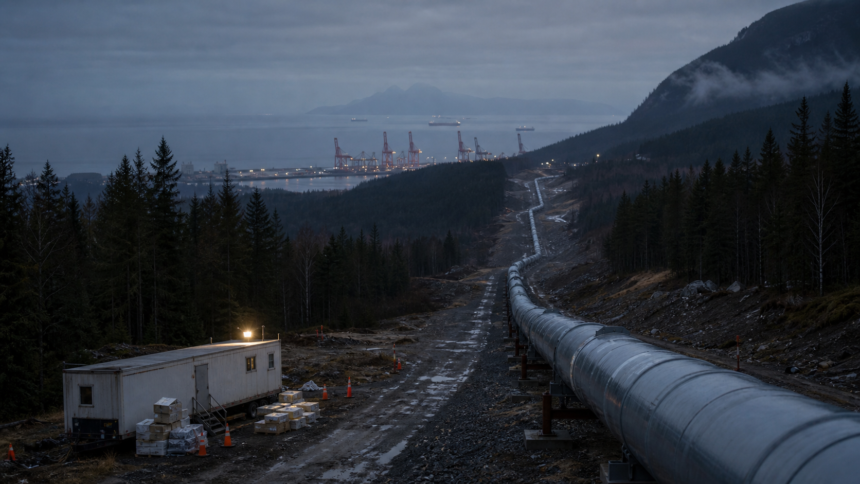
Alberta waited a decade for a line to the Pacific. One finally arrived, carrying the most expensive policy lesson this country has ever paid for. When Kinder Morgan scoped the Trans Mountain expansion in 2013, the engineering pointed to a bill around $5.4 billion, with private capital lined up to pay it. By the time oil moved in 2024 the project sat on federal books at roughly $34 billion, six times the figure it was born with.
The pipeline itself is a good thing. Be clear about that. Alberta crude reached tidewater, production set records, the discount on Canadian barrels narrowed, and the country finally earned world prices on a meaningful share of its exports. The asset works. The lesson is in how it was delivered.
How a Project Gains $28 Billion
The sequence matters. Political risk, regulatory churn and provincial obstruction drove the private owner to the exit in 2018. Ottawa bought the project to keep it alive, which was better than letting it die, and then delivered it the way governments deliver megaprojects. Costs ballooned through every season of delay, litigation, route fights and gold-plated requirements. The Parliamentary Budget Officer has cautioned that the eventual sale is likely to leave taxpayers billions short. No shareholder vote ever reviewed the spending, because there were no shareholders left to ask.
Private money abandons projects the moment they stop penciling. Brutal, yes, and exactly the point. Public projects, insulated from it, continue regardless, and the overruns land on people who never signed up for the risk. Albertans, who pay federal taxes like everyone else, financed a pipeline they had already waited a decade for the private sector to build twice.
Capital Did Not Stop Believing in Pipe. It Stopped Believing in Canada
Look at where the money went instead. Capital budgets across Canadian oil and gas reached about $40.6 billion in 2024. American shale outfits deployed better than three times as much. Engineering teams drifted to Houston. Producers sought American listings. None of those boards doubted the economics of moving oil. They doubted the rules, the timelines and the politics of building anything here.
Northern Gateway died on a federal order. Energy East died under shifting regulatory goalposts. Trans Mountain survived only by nationalization. Three data points make a trend, and capital reads trends for a living.
The Next One Has to Be Different
A new Pacific pipeline is now on the national agenda, with a federal-provincial agreement, a target construction date and the country’s largest operator circling. Nobody can finance a sequel to the $34 billion miracle. There is no appetite, no fiscal room and no excuse. It has to be financed by private balance sheets, which means the conditions that drove private money out, the open-ended timelines, the duplicate reviews, the political veto points, have to actually be gone, not merely renamed.
Alberta was told for years that its resources were the liability. The arithmetic says otherwise. The liability was the delivery model, and the country paid six times the estimate to prove it.
Would you trust the next pipeline to private capital under firm rules, or should government stay in the building business? Tell us below.