
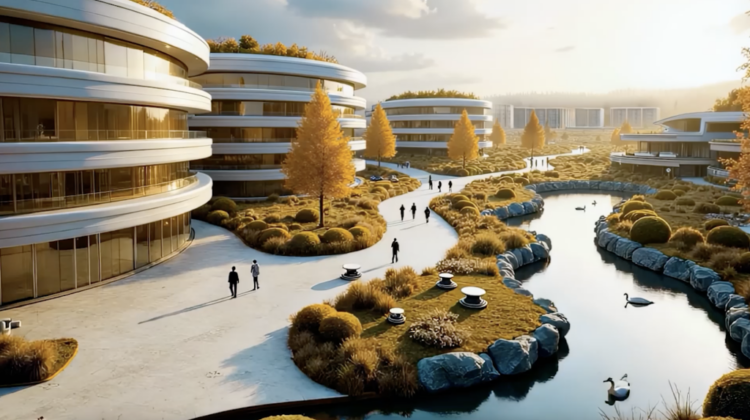

Hundreds of people from around Grande Prairie filed into a June 4 open house to size up Wonder Valley, the AI data centre campus proposed for the Greenview region. The numbers attached to the project explain the turnout. A build-out cost near $70 billion. A 64-square-kilometre footprint. Power demand in the nine-gigawatt class. Water draw that could reach six million cubic metres annually at maturity.
Projects of that scale change a region permanently, mostly for the better when they are done right. Jobs, assessment base, gas demand, service contracts, a generation of skilled work anchored in northwest Alberta. This is exactly the kind of investment the province built its data centre framework to attract, and Wonder Valley picked Alberta for reasons that flatter the province. Land, gas, cold air and rules a board of directors can price.
Scale Demands Process
But the open house itself produced a complaint worth taking seriously. Organizers ran it as a walk-around, display boards with staff posted at stations. Plenty in the crowd wanted the older format instead, the town hall, where questions get asked before neighbours and answered before neighbours, on the record.
For a project consuming gigawatts and millions of cubic metres of water, that is an entirely reasonable expectation. Display boards are fine for a subdivision. A development the size of a city deserves a microphone.
Predictability Is Alberta’s Real Advantage
Geography was never the whole of Alberta’s data centre advantage. The real edge is predictability, and predictability binds both sides. When a weak data centre application landed at Olds, the utilities commission rejected it, and that rejection did more for Alberta’s reputation among serious investors than any incentive program could. Standards attract capital. Shortcuts attract trouble.
Consultation belongs in the same category. A community that gets straight answers early becomes a project’s ally for thirty years. A community that feels managed becomes the lawsuit, the council fight and the protest that investors price as risk. Alberta has watched that movie from the other side of the pipeline debate for a decade. It should not produce a local remake.
Get Both Right
None of this requires slowing the project down. It requires running the engagement with the same professionalism as the engineering. Public sessions where questions get answered aloud. Clear water and power data published where residents can read it. Firm commitments on municipal benefit, recorded where they can be enforced. The companies behind projects this size have the resources to do consultation properly. The province has every reason to insist.
Investment at world scale has to be met with engagement at the same standard. Albertans are not the obstacle to the data centre boom. They are the reason it has somewhere worth landing.
Town halls or display boards. How should projects this size face the public? Tell us below.
Frequently Asked Questions
Wonder Valley is a proposed AI data centre industrial park in Alberta’s Municipal District of Greenview, developed with O’Leary Ventures and billed as the world’s largest, with a lifetime investment of more than $70 billion.
It would cover roughly 64 square kilometres and include up to nine gigawatts of on-site power generation once all phases are complete, beginning with a first phase of about 1.4 gigawatts.
The Greenview site offers abundant natural gas, existing permits, nearby pipeline and fibre-optic infrastructure, a cold climate that aids cooling, and a clear provincial regulatory framework for data centres.