


Paul Brandt did not send a tweet. He testified before a Senate committee on bail reform.
On Thursday, April 23, 2026, the Calgary-born country artist and founder of #NotInMyCity appeared as a formal witness before the Standing Senate Committee on Legal and Constitutional Affairs, studying Bill C-14, the federal Bail and Sentencing Reform Act. He appeared as Founder and Chief Executive Officer of Not In My City. Not as a celebrity. Not as a symbolic presence. As someone who has spent close to two decades doing the work that most people only discuss.
The national media covered the Winnipeg mayor who testified at the same hearing. Paul Brandt received almost no coverage. That gap deserves attention.
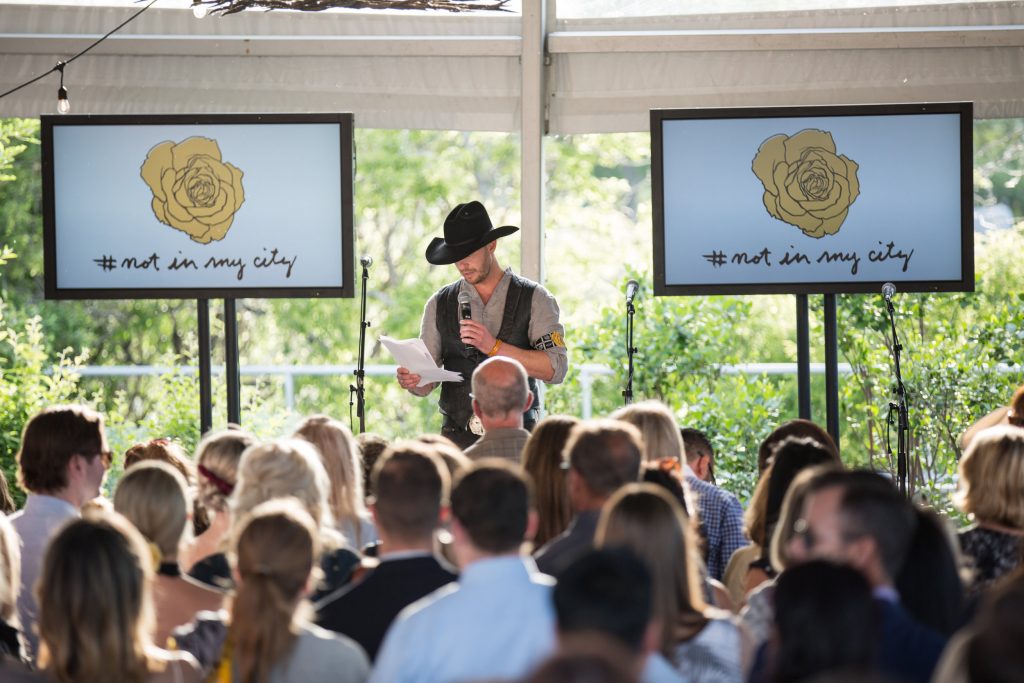
What Paul Brandt Built at Not In My City
Most Canadians know Brandt from “Alberta Bound” and “My Heart Has a History.” Before the music, he was a registered nurse at the Alberta Children’s Hospital in Calgary. He released his debut album in 1996 and became the most-awarded Canadian male country artist in history.
What rarely makes the biography is what came after the stages and the awards.
Brandt and his wife Elizabeth co-founded Not In My City in July 2017. The organization is built on a direct principle: awareness without action changes nothing. Not In My City now operates in partnership with more than 40 Canadian airports, providing training to help staff identify and respond to signs of trafficking. The yellow rose displayed in airport terminals across the country is its symbol. It means that people in that building have been trained to act.
He chaired the Alberta Human Trafficking Task Force. The provincial government accepted 18 of 19 recommendations. The most significant one created the Alberta Centre to End Trafficking.
Brandt also built the Maddison Sessions, which bring together more than 100 investigators from across Canada to share intelligence and coordinate strategy. The sessions are named after a young Alberta woman who lost her life to the crime.
In early 2026, Brandt presented at a Grand Rounds session with the Department of Emergency Medicine in Calgary on identifying trafficking in clinical settings, addressed the Pediatric Trauma Committee in Edmonton, and spoke to the Cochrane Generals junior hockey team about recognizing exploitation in their communities. Not In My City is also actively petitioning Parliament to reinstate mandatory minimum sentences for possession of child sexual abuse material, following the Supreme Court’s 5-4 ruling in Attorney General of Quebec v. Senneville on October 31, 2025, which struck down those minimums. That petition had gathered more than 5,400 signatures as of early 2026.
Brandt also serves as Co-Chair of the Governing Board of the Alberta Centre to End Trafficking. The country music career is the side note now.

Bill C-14 and the Bail Reform Problem Across Canada
Bill C-14, the Bail and Sentencing Reform Act was introduced in Parliament on October 23, 2025. It contains more than 80 proposed changes to the Criminal Code, targeting the conditions under which violent and repeat offenders can obtain bail. It expands reverse onus provisions for serious crimes, tightens release conditions for those with prior violent convictions, and restricts house arrest for serious sexual offences. The bill passed the House of Commons and reached second reading in the Senate on February 24, 2026. It is currently in committee study.
93%of identified trafficking victims in Canada are women and girls, according to Statistics Canada. Roughly one in four is under the age of 18. The largest group, approximately 42%, is aged 18 to 24.
Source: Statistics Canada, Trafficking in Persons in Canada, 2024 (Juristat)
Human traffickers are not one-time offenders. They are organized, repeat violent criminals who rely on gaps in the justice system to stay operational. They get arrested. They get bail. They return to their networks. They re-offend. Their victims pay the price while the cycle continues. This is the pattern Brandt has documented and fought against through close to two decades of advocacy, and it is the pattern that Bill C-14 is designed to interrupt.
The Winnipeg Police Service told the same Senate committee that more than 80% of arrests made by its joint warrant unit in both 2024 and 2025 involved offenders already on bail, probation, or parole. The most common violation in both years was a bail breach. That unit averages one arrest per day and was created specifically to target violent repeat offenders.
That data is not specific to Winnipeg. It describes a national pattern. It is also the operational reality that Not In My City confronts every time one of its airport partners identifies a trafficker who has been released and returned to their network.

What the Coverage Gap Actually Means
The Winnipeg mayor received wide national coverage for his April 23 testimony. He is an elected official and his appearance was substantive. That attention was warranted.
The near-silence around Brandt is harder to justify. He is not a bystander offering an opinion. He is the founder and CEO of a national organization with active operations in more than 40 airports, a provincial task force chair, and the person whose recommendations produced the Alberta Centre to End Trafficking. He brings close to two decades of direct, frontline experience in exactly the area of criminal behaviour that Bill C-14 is designed to address. His testimony is not background colour. It is primary evidence from someone who has watched this problem operate in real time across Canadian communities for the better part of twenty years.
Parliament hears from many credentialed witnesses. It hears from fewer people who have actually built something durable in response to the problem they are describing.
That distinction should carry weight in how hearings are reported. The habit of covering the most prominent political figure in the room while the practitioner with the deepest track record goes unnoticed is not new. But it is visible here, and it costs something each time it happens.

What Alberta Sends to Ottawa
There is a larger point worth making.
When Alberta produces someone like Paul Brandt — a man who converted a platform built on stadium tours and radio singles into a national anti-trafficking infrastructure, who chaired a government task force, turned 18 of his 19 recommendations into provincial policy, and now appears before a Senate committee on behalf of victims — that reflects something real about what this province expects from its public figures.
He did not wait for a federal program to define the response. He built Not In My City, trained more than 40 airports, helped establish the Alberta Centre to End Trafficking, convened national investigators year after year, and then showed up before a Senate committee when the legislation he had been advocating for finally arrived.
That is what serious, sustained advocacy looks like. It takes years. It produces institutions. It shows up in the room even when the cameras are pointed elsewhere.
Alberta has been sending this kind of person to Ottawa for a long time. Ottawa should get better at paying attention when they arrive.