



Alberta’s Carbon Price Freeze and the Limits of Federal Leverage
Alberta’s decision to hold its industrial carbon price at $95 per tonne in 2026 is not a symbolic gesture. It is a deliberate policy choice that reopens a long-standing tension in Canadian federalism, namely how far the federal government is prepared to go to enforce national climate standards when a province declines to follow the prescribed path.
The move places Ottawa in an uncomfortable position.
It must now decide whether national benchmarks are binding rules or flexible targets shaped by political and economic realities on the ground.
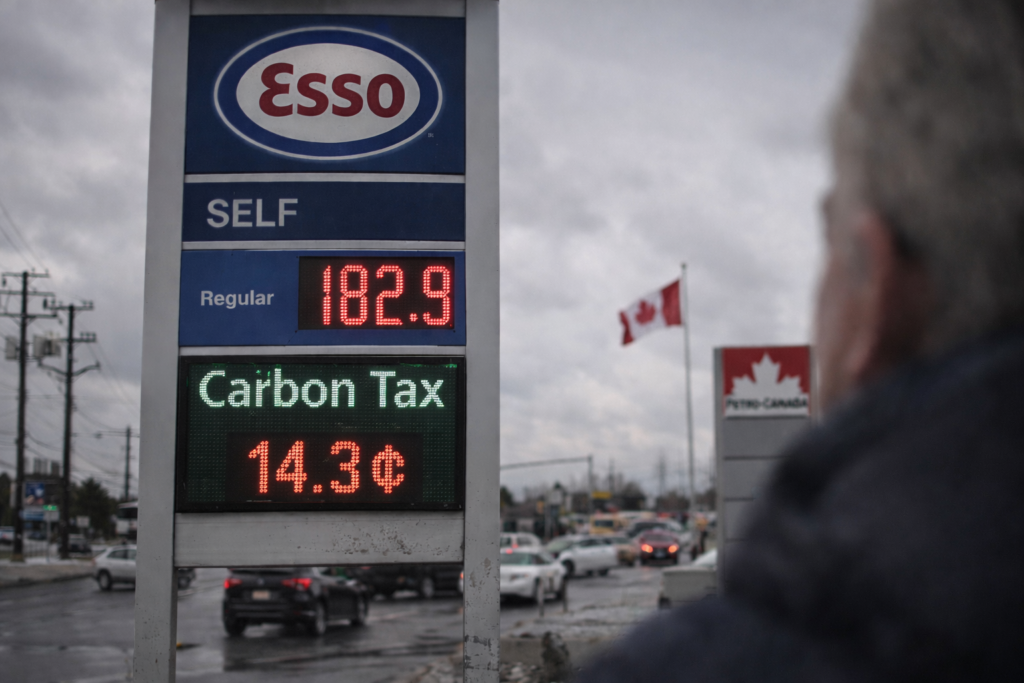
A calculated provincial move
Alberta’s large-emitter system has been in place for years, operating alongside the federal carbon pricing framework rather than in opposition to it. The system applies to industrial facilities, not households, and is structured so that compliance costs are largely reinvested into emissions reduction projects, efficiency upgrades, and technology development within the province.
By freezing the price, Alberta is choosing not to mirror the next scheduled increase in the federal benchmark. The province argues that further escalation risks undermining competitiveness at a time when energy producers, manufacturers, and exporters face rising capital costs and uncertain global demand. The concern is not abstract. Large industrial projects are planned years in advance, and regulatory instability can weigh heavily on final investment decisions.
This is less a rejection of climate policy than a challenge to how quickly costs should rise and who bears them.
Federal authority and its limits
The federal government’s legal footing is not in doubt. In 2021, the Supreme Court of Canada upheld the constitutionality of the federal carbon pricing backstop, affirming Parliament’s authority to address climate change as a matter of national concern. At the same time, the court emphasized that provinces retain wide discretion in designing their own systems, provided they meet minimum national standards.
That balance is now being tested.
Ottawa insists that carbon pricing only works if the benchmark applies uniformly across the country. Without consistency, the policy risks becoming fragmented, with provinces effectively choosing their own thresholds. Alberta, for its part, maintains that its system reflects regional economic conditions and that price alone should not be the sole measure of stringency.
Both positions are defensible, and neither resolves the practical question of enforcement.
Enforcement comes at a cost
Imposing the federal backstop on Alberta’s industrial sector would be politically and administratively difficult. Many facilities operate under long-term compliance plans approved by provincial regulators. Others are part of integrated supply chains that cross provincial and international borders.
An aggressive federal response could also undermine Ottawa’s broader message that climate policy depends on cooperation with provinces. At a time when the federal government is offering generous tax credits and incentives to attract investment in clean technology and energy infrastructure, a public confrontation risks sending mixed signals to the same investors it is trying to court.
Yet allowing Alberta to diverge without consequence carries its own risks. Other provinces would take note. The credibility of a national benchmark depends on the perception that it is enforceable.
Economic context matters
This dispute is unfolding against a challenging economic backdrop. Inflation has moderated but remains a concern for businesses with narrow margins. Interest rates are higher than they were only a few years ago. Global competition for capital has intensified, particularly in emissions-intensive industries that face overlapping regulatory regimes in multiple jurisdictions.
Governments at all levels are attempting to balance emissions reduction goals with economic resilience. That balancing act becomes more difficult when policy instruments are perceived as inflexible or disconnected from regional conditions.
Alberta’s decision reflects a broader skepticism toward one-size-fits-all approaches, especially when they impose rising costs during periods of economic uncertainty.
Risks on both sides
Alberta is not without exposure. A prolonged standoff could create uncertainty that discourages investment rather than preserving it. Companies value predictability as much as they value cost control. There is also the possibility that Ottawa responds indirectly, through slower approvals or reduced flexibility in other policy areas where federal discretion plays a role.
For the federal government, the risk lies in precedent. If benchmarks can be paused under political pressure, the long-term integrity of national climate policy may erode. The federal system relies on negotiated compliance, but negotiation loses force if there is no credible backstop.
What comes next
The most likely outcome is not an immediate showdown but a period of quiet negotiation. Ottawa may seek technical adjustments that allow Alberta to demonstrate equivalent emissions performance without formally increasing the price. Alberta may offer assurances tied to emissions intensity or sector-specific outcomes rather than headline figures.
Such compromises are common in Canadian federalism, even when public rhetoric suggests otherwise.
Still, the underlying issue remains unresolved. Climate policy in Canada depends on cooperative federalism, but cooperation becomes strained when economic pressures intensify and political timelines narrow.
Alberta’s carbon price freeze has forced Ottawa to confront an uncomfortable choice. Enforce national standards and risk political and economic fallout, or accommodate provincial resistance and weaken the perception of uniform rules.
How the federal government responds will shape not only climate policy, but the practical limits of federal authority in Canada’s decentralized system.