

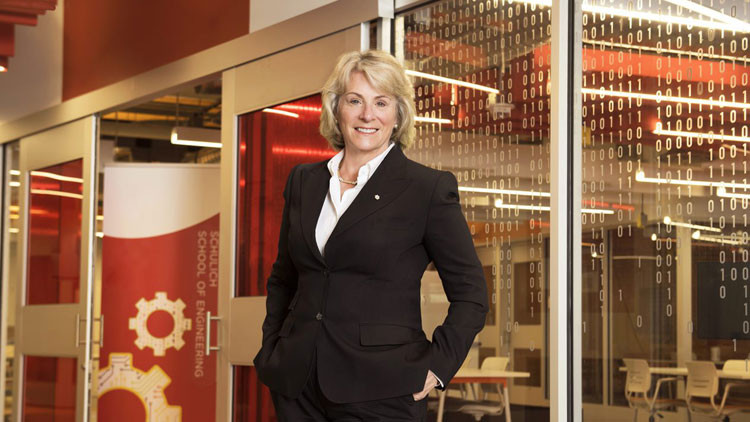
Long before GPS was in every pocket, Elizabeth Cannon was writing the software that made it work. The Calgary geomatics engineer built a career that moved from satellite navigation research to the presidency of the University of Calgary, a path that took her from a small East Coast university to the top ranks of Canadian higher education. In 2022, Elizabeth Cannon was inducted into the Alberta Order of Excellence for a career that combined scientific discovery, entrepreneurship, and a sustained push to bring more women into engineering classrooms.
An Unlikely Path Into Geomatics
Margaret Elizabeth Cannon was born on June 25, 1962, in Charlottetown, Prince Edward Island, the youngest of four children in a household where her father worked as an entomologist and her mother taught high school math and science. After completing a mathematics degree at Acadia University in Nova Scotia in 1982, she moved to Calgary to join a new geomatics engineering program at the University of Calgary’s Schulich School of Engineering, a field she had chosen because it let her use math and science to solve real problems rather than study them in the abstract. A summer job at Nortech, an early adopter of satellite navigation technology, opened the door to the research that would define her career.
Building the Software Behind GPS
Elizabeth went on to invent or co-invent eight software programs for processing GPS data, eventually licensing the technology to more than 200 agencies worldwide through over 3,000 sublicenses. A 1989 paper she wrote about her GPS software caught the attention of a Norwegian government agency, an early sign of the international reach her research would eventually have. That same year, the massacre of fourteen female engineering students at Montreal’s Ecole Polytechnique reshaped how she thought about her role in the field. She became an Assistant Professor of Geomatics Engineering at the University of Calgary in 1991, the year she completed her PhD, and in 1997 was appointed to the NSERC and Petro-Canada Chair for Women in Science and Engineering, a position she used to promote STEM education among young women.
From Dean to University President
Elizabeth published more than 350 papers and research reports, co-authored three patents, and supervised 49 graduate students over the course of her academic career, work that helped the Schulich School of Engineering reach one of the highest proportions of female undergraduates among major Canadian engineering schools. She was appointed Head of Geomatics in 2004 and became Dean of the Schulich School of Engineering two years later, the first woman to hold that role. From 2010 to 2018, she served as the University of Calgary’s eighth president and vice-chancellor, also the first woman and first alumna to hold that position. Under her leadership, the university launched its Eyes High strategic plan and the Energize fundraising campaign, the third-largest completed campaign in Canadian university history, and rose into the top five of Canada’s research universities, according to her Alberta Order of Excellence profile. Sponsored research funding grew by 48% during her tenure, and the university secured $900 million in additional government funding for infrastructure, research, and education.
A Continuing Voice for Alberta’s Tech Sector
Elizabeth has received more than 80 awards and recognitions over her career, including the Engineers Canada Gold Medal, the Queen Elizabeth II Diamond Jubilee Medal, and, in 2019, appointment as an Officer of the Order of Canada. In 2022, alongside her induction into the Alberta Order of Excellence, she was named to the Junior Achievement Southern Alberta Business Hall of Fame. She continues to serve on boards including the Rideau Hall Foundation and the Alberta Enterprise Corporation, and remains an active mentor to female entrepreneurs through groups such as Creative Destruction Lab and The51. Elizabeth lives in Calgary with her husband Gerard Lachapelle, also a geomatics engineer, and their two children, Sara and Rene.
What might Alberta’s next wave of engineers accomplish with a mentor like Elizabeth Cannon standing in front of their classroom?