

Dr. Merle Olson grew up doing farm chores in southern Saskatchewan and ended up transforming veterinary medicine for producers across Alberta. In 2021, the Government of Alberta inducted him into the Alberta Order of Excellence, honouring a career that carried him from a mixed 640-acre farm to a Calgary biotech company built on his own research. His Alberta Order of Excellence profile describes a scientist whose respect for animals began with milking cows before school.
A Farm Boy With a Head for Science
Merle Edwin Olson was born in Radville, Saskatchewan, in 1953, the younger of two boys on a farm that raised cattle, chickens and pigs alongside wheat. By 12 he was responsible for the livestock, and he earned extra money trapping beavers, mink and muskrats to sell to the Hudson’s Bay Company. Merle attended school in the village of Ceylon, switching to homeschooling in winter when roads were often snowed in. Strong in math and science despite what would now be understood as Attention Deficit Disorder, he graduated valedictorian of his ten-student class in Ceylon, Saskatchewan, then went on to the University of Saskatchewan, Regina Campus, before completing a master’s degree in electrochemistry at Western University. Realizing his real calling was working with animals, he entered veterinary college at the University of Saskatchewan that same year.
A Flat Tire and a Research Partnership
While studying for his doctorate of veterinary medicine, Merle stopped to help a fellow student fix a flat tire. That student was Barb, a grad student in veterinary physiology who would become his wife and lifelong research partner. After graduating in 1981, Merle joined a two-person large-animal practice in Pincher Creek, Alberta, working demanding hours through calving season, before research drew him back to academia at the University of Calgary in 1984. There he helped lead the Biofilm Research Group, investigating how bacterial biofilms protect themselves from antibiotics, work that produced the Calgary Biofilm Device, now used worldwide in human and veterinary medicine.
Building Alberta Veterinary Laboratories
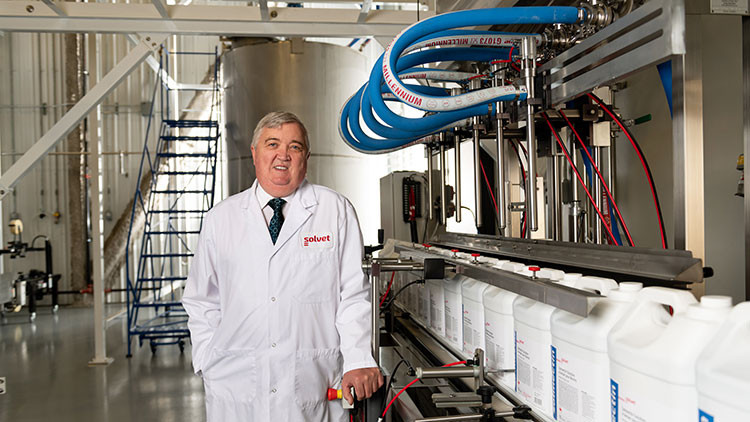
In 2004, Merle and Barb left the university to build made-in-Alberta veterinary pharmaceuticals, founding Innovotech, Alberta Veterinary Laboratories and Solvet Animal Health. Merle had seen firsthand, both as a rural vet and a professor, how few livestock pharmaceuticals were made with Alberta’s climate and producers in mind. AVL’s Ivermectin Pour-On for Cattle brought competition into the parasite-control market and has saved the industry an estimated $9 million annually since 2009, while the company’s pain-control products became standard tools for veterinarians handling difficult procedures. Merle also led the reverse-engineering of Alfasure, a bloat-control treatment that let cattle safely graze on high-protein alfalfa. AVL has grown to more than 50 employees, including chemists, biochemists, pharmacists, veterinarians and engineers, and has registered at least one new veterinary product every year it has been in business.
A Lifetime Recognized
Merle’s work earned him the Charles River Award in Laboratory Animal Care in 1992, the Alberta Veterinary Medical Association’s Veterinarian of the Year Award in 1997 and Alberta Farm Animal Care’s Award of Distinction for Innovation in 2016. He and Barb hold more than 50 patents and have published over 250 peer-reviewed papers between them, splitting their time between Calgary and a log home in Canmore that Merle helped build with his own hands.
Merle and Barb’s research also crossed into human medicine. Working with Alberta physicians and scientists, they helped develop RhinoRinse, a nasal flush solution, and contributed to Acticoat, a silver antimicrobial bandage now used in wound care. Even after two decades in business, the pair kept experimenting, most recently working on a new delivery method to extend pain-control treatment for band-castrated livestock, still asking the same practical question that started their partnership: what does this animal actually need. Merle and Barb still live in Calgary during the week and spend weekends at their Canmore log home, built with timber they harvested, cut and shaped themselves, close to the mountain trails they have hiked, skied and cycled together for decades.
What does it take to turn a childhood spent on a Saskatchewan farm into a career that reshapes how an entire industry cares for its animals?