


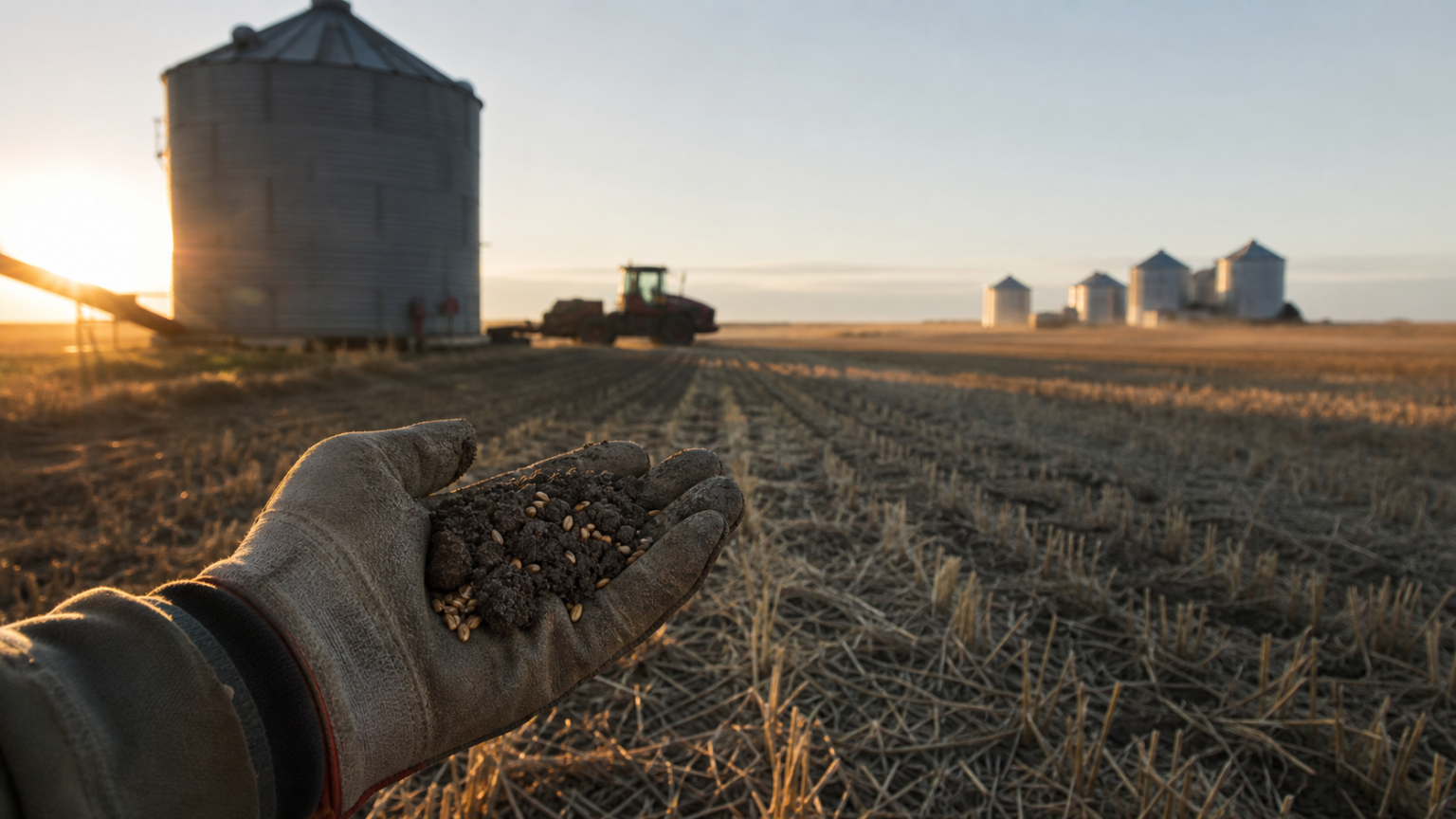
Canadian farmers are on track to spend $22.5 billion on crop inputs in 2026, a figure that Farm Credit Canada projects could rival the cost record set in 2022. Fertilizer alone is expected to account for nearly $10 billion of that total, with prices elevated heading into the growing season and grain prices offering thin cover. Alberta producers face the same squeeze, and in some input categories the situation is more acute than the national average suggests. Geopolitical disruptions affecting diesel and fertilizer supply chains have tightened margins further since late 2025. None of this is a background condition. It is the operating environment for the people responsible for producing the food that fills Alberta grocery stores and Canadian export containers.
Input Costs and Who Bears Them
Agriculture is structurally different from most industries in one important respect: primary producers do not set their own prices. A farmer cannot raise the price of canola because fertilizer costs went up. The commodity price is set by a market the individual producer cannot influence. What the producer can control is cost structure, and when input costs rise faster than commodity prices, the margin compression is absorbed entirely on the farm. No pass-through, no adjustment period. The money comes out of operating capital or debt capacity, and sometimes out of the decision to continue farming at all.
In Alberta, both urea and anhydrous ammonia, the dominant nitrogen fertilizer inputs for cereal and oilseed production, are manufactured using natural gas as a feedstock. Production costs for domestically manufactured fertilizer therefore carry an industrial carbon cost that flows through to the farmer at the point of purchase. The federal consumer carbon tax was eliminated effective April 1, 2025, which provided meaningful relief on farm fuel costs. That was a genuine improvement. But the industrial carbon price that applies to large emitters, including fertilizer plants, remained in place, meaning some of the upstream manufacturing cost is still carbon-affected, and that cost is still embedded in what the producer pays per tonne.
The Policy Environment Around Production
Alberta’s farm input price survey, maintained by the provincial Agriculture and Irrigation ministry, tracks more than 50 representative inputs on a monthly basis. The data available through spring 2026 reflects an environment where input costs are elevated relative to the commodity price environment. Farm Credit Canada’s preliminary 2026 outlook flagged the potential for fertilizer-to-crop-price ratios to move against producers as the season progressed. That is the technical way of saying margins are thin and could get thinner.
This matters for a conversation that Canadians have increasingly often without understanding where it starts. Food security is frequently discussed as a question of grocery store prices, supply chain logistics, or retail competition. All of those downstream factors are real. None of them can substitute for a primary sector that is financially viable. A food chain that begins with producers operating at breakeven or below is a fragile one. The grocery store depends on the processor. The processor depends on the elevator. The elevator depends on the harvest. The harvest depends on a producer who could afford to plant. Take financial viability out of the first link and the rest of the chain weakens regardless of what policies you apply further downstream. For context on how input-side costs interact with Alberta’s broader fiscal environment, see our reporting on carbon pricing and the oil patch.
What Competitive Conditions Actually Require
Keeping Alberta’s agricultural sector competitive does not require eliminating every regulatory cost or pretending that production has no environmental consequences. It requires that the policy burden on producers be calibrated against their actual margin structure. A manufacturing company operating on a 20% margin can absorb a compliance cost that would eliminate a grain farmer operating on 3%. Treating those two businesses as equivalent in the policy design is not neutral. The removal of the consumer carbon price was a step toward recognizing this. Completing that recognition means ensuring that industrial carbon costs embedded in input manufacturing are also accounted for in farm program design, whether through input rebates, expanded exemption categories, or alternative mechanisms.
Alberta’s cattle sector, which has its own cost pressures around feed and land, and its grain and oilseed producers together represent the productive foundation of a food supply that extends well beyond this province’s borders. The Bar U Ranch, now a national historic site, marks how deeply ranching has shaped Alberta’s landscape and identity. See our piece on Alberta’s cattle history for a longer view of what this sector has built. Protecting that foundation requires policy designed around how farming actually works financially, not how politicians and commentators imagine it works.
The Simple Principle
Food security is not an abstract national objective that can be separated from the economics of primary production. Every time a policy decision adds cost to the farm without adding capacity to the market price, the buffer between a viable producer and a former one shrinks a little. Enough of those decisions, accumulated over time, produce a thinner, more concentrated, more fragile agricultural sector. Alberta has the land, the water, the expertise, and the infrastructure to be a food-producing powerhouse for generations. Maintaining that advantage requires treating the producer’s margin as a policy variable, not an afterthought.
What should Ottawa or Edmonton do first to reduce the cost burden on Alberta farm operations ahead of the next growing season?