

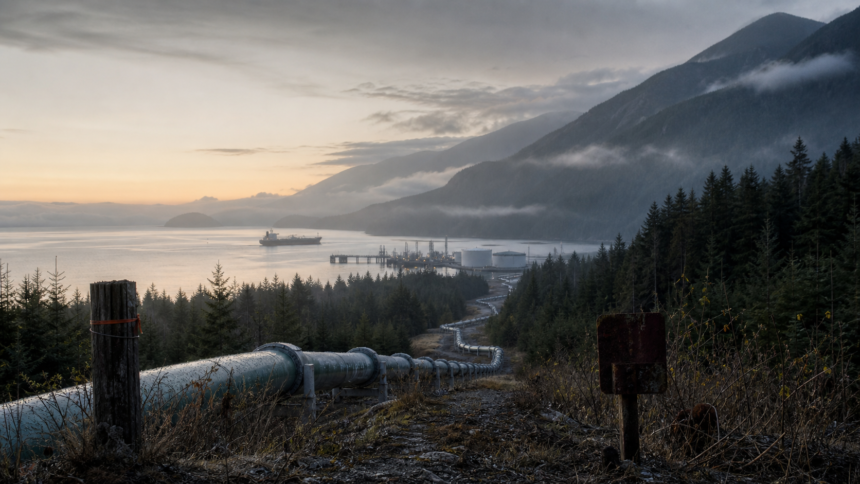
Ten years ago, the federal government ordered Northern Gateway dead. The company behind it was Enbridge. The destination was the British Columbia coast. The cargo was Alberta crude headed for Asia.
The Implementation Agreement signed in Calgary on May 15 commits both governments to a new line to tidewater, sized above a million barrels daily and aimed squarely at Asian buyers. Enbridge’s chief executive needed only hours to confirm, on the record, that the company would weigh a role. Same company. Same coast. Same product. A decade of lost time in between.
What the May 15 Agreement Actually Says
The agreement, signed by Prime Minister Mark Carney and Premier Danielle Smith, sets out a schedule rather than a slogan. Alberta intends to put a proposal in front of the federal Major Projects Office by July 1. A federal national-interest designation carries a due date of October 1 this year. The earliest construction window opens September 1, 2027. The deal is tied to the Pathways Alliance carbon capture project in the oil sands, and it softens the industrial carbon price trajectory that producers had been told to swallow.
No private proponent has formally signed on yet, and that caveat matters. But the signal from the country’s largest pipeline operator arrived almost immediately, and it was the signal Alberta has waited more than a decade to hear. Routes, partners and regulatory pathways remain unsettled. The direction of travel does not.
The Math Always Worked
Albertans spent ten years hearing every reason it could never happen. The business case was supposedly thin. The optics were supposedly wrong. The politics were supposedly impossible. Yet through that entire decade, the underlying arithmetic never moved. Asia kept buying oil. Alberta kept producing it, setting production records along the way. The discount on landlocked Canadian crude kept transferring wealth from Canadian workers to American refiners.
What changed was never the spreadsheet. What changed is that the cost of saying no finally became visible. Gasoline prices in central Canada climbed. Europe and Asia went looking for reliable suppliers and found a country that could not get its product to its own coastline. A federal government that spent years treating Alberta’s flagship industry as a liability discovered, under pressure, that it was the country’s strongest card.
The Cost of the Lost Decade
It is worth being precise about what that decade cost. Northern Gateway was approved, litigated, and then extinguished by federal direction in 2016. Energy East died the following year under shifting regulatory goalposts. Investment that should have flowed into Canadian steel, Canadian engineering and Canadian wages went to the Gulf Coast and the Permian instead. Estimates of forgone revenue run into the tens of billions of dollars, and none of that buys back the careers, the contracts or the communities that absorbed the hit.
Through it all came the lectures about patience and process, and consultations that somehow refused to end. The same political class that buried two nation-scale projects now describes a new one as urgent national policy. The reversal is welcome. It is also an admission, even if nobody in Ottawa will phrase it that way.
Leverage, Not Luck
This moment did not arrive because attitudes softened. It arrived because Alberta kept raising the price of federal inaction until a deal became the cheaper option. The province held its ground on competitiveness, kept producing, kept the file in front of the country, and let arithmetic do the persuading. That is what leverage looks like when it is exercised patiently.
Skepticism is still warranted. British Columbia’s government remains hostile, consultation obligations are real, and a construction date eighteen months out is a target rather than a guarantee. Albertans have seen paper victories before. But there is no version of this story in which the last decade was anything other than an expensive, avoidable detour, paid for almost entirely by one province.
No fresh business case was ever required here. The only missing input, all along, was a federal government willing to get out of the road.
Does Enbridge’s return close the book on the lost decade, or should Ottawa still answer for it? Tell us below.