


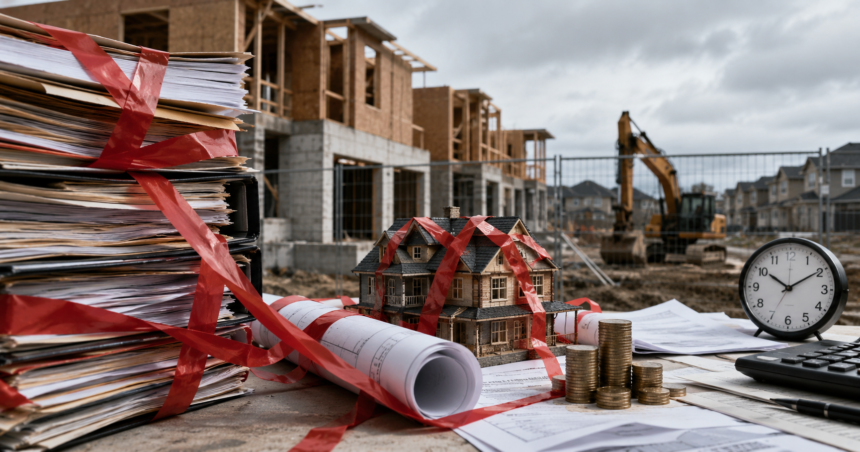
Canada’s housing crisis did not appear overnight and it certainly did not happen because builders suddenly forgot how to build homes. What changed was the system surrounding housing approvals. Over the last 30 years, governments gradually turned the process of building homes into an obstacle course of studies, delays, redesigns, hearings, and bureaucracy.
The result is planning paralysis, and Canadians are paying for it in both time and money.
In the 1990’s, it was common for many housing projects to move from application to construction within months. Municipal governments still reviewed projects carefully, but the process was far more straightforward. Today, according to the Canadian Home Builders’ Association Municipal Benchmarking Study, approval timelines in many major municipalities stretch between 18 months and 31 months after an application is considered complete. That does not even include the years spent assembling land, navigating policy changes, or waiting for servicing allocation before an application officially enters the process.
By the time many projects finally receive approval, 4 to 6 years may already have passed. Then construction still has to begin.
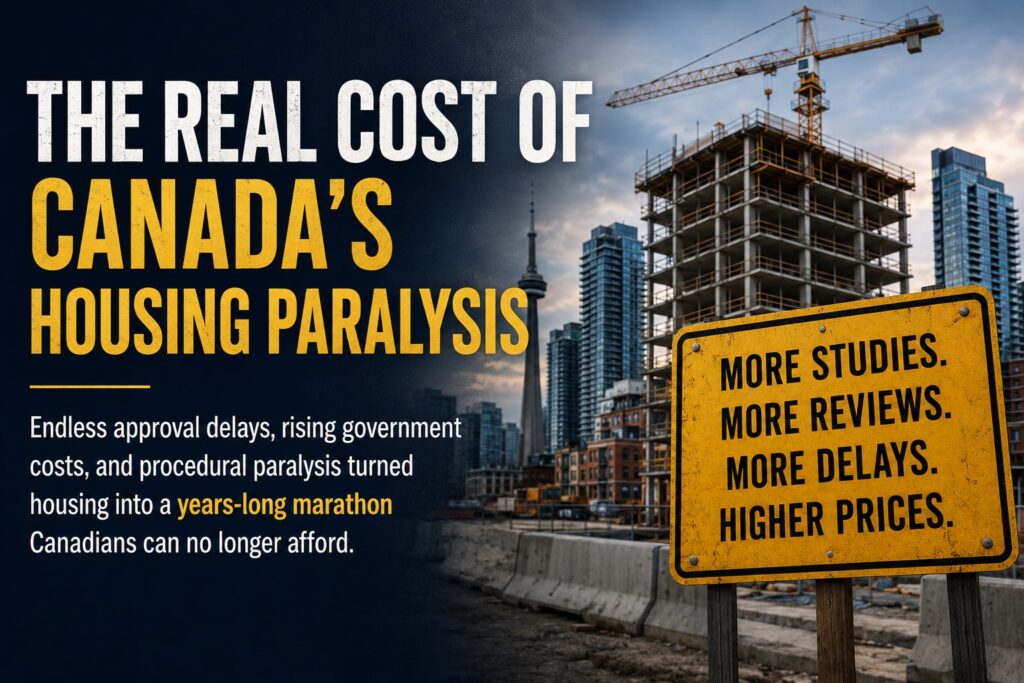
The Canada Mortgage and Housing Corporation has estimated that many multi-family developments now take 7 to 8 years from concept to occupancy once approvals and construction are combined. Think about how insane that really is. A child can enter elementary school and be halfway to high school before some housing projects are finally completed in Canada.
Meanwhile, governments keep asking why supply cannot keep up.
The financial cost of these delays is enormous. Every extra month means developers continue paying interest on land loans, property taxes, consultant fees, legal fees, engineering costs, and inflation-adjusted construction pricing. According to CHBA research, delays can add anywhere from several thousand dollars to well over 10,000 dollars per month per unit, depending on the municipality and scale of the project.
Then there are development charges, which have exploded across the country. In some municipalities, government-imposed fees now approach or exceed 200,000 on a single low-rise home before construction even begins. None of these costs disappears. They eventually land directly on the price paid by the buyers.
And somehow we still pretend this has nothing to do with affordability.
The numbers become even more striking when comparing housing output over time.
In 1990, Canada had a population of roughly 28 million people and produced approximately 200,0000 housing starts annually. A large share of those homes were practical family-oriented housing, including detached homes, duplexes, and townhomes built for long-term ownership.
Fast forward to today. Canada’s population is approaching 42 million people, yet annual housing starts are still sitting around 240,000 thousand units nationally. In other words, Canada added nearly fourteen million more people but is building only modestly more housing than it did over three decades ago.
At the same time, the product mix has changed dramatically.
As opposed to the 1990s, a larger share of today’s housing consists of small condominium apartments rather than family-oriented ground-based housing. In many major cities, ownership opportunities for young families have been pushed further and further out of reach. This was not simply market evolution. Government policy, delays, land restrictions, and rising municipal costs heavily shaped this outcome.
This is the uncomfortable truth politicians rarely want to discuss. Canada does not simply have a housing shortage. It has a decision-making shortage.
We are trying to solve a modern housing crisis with approval systems that become slower, more political, and more bureaucratic every single year.
Until governments start treating housing approvals with urgency instead of an endless process, affordability will continue slipping further away from ordinary Canadians.
Written by Shane Wenzel