

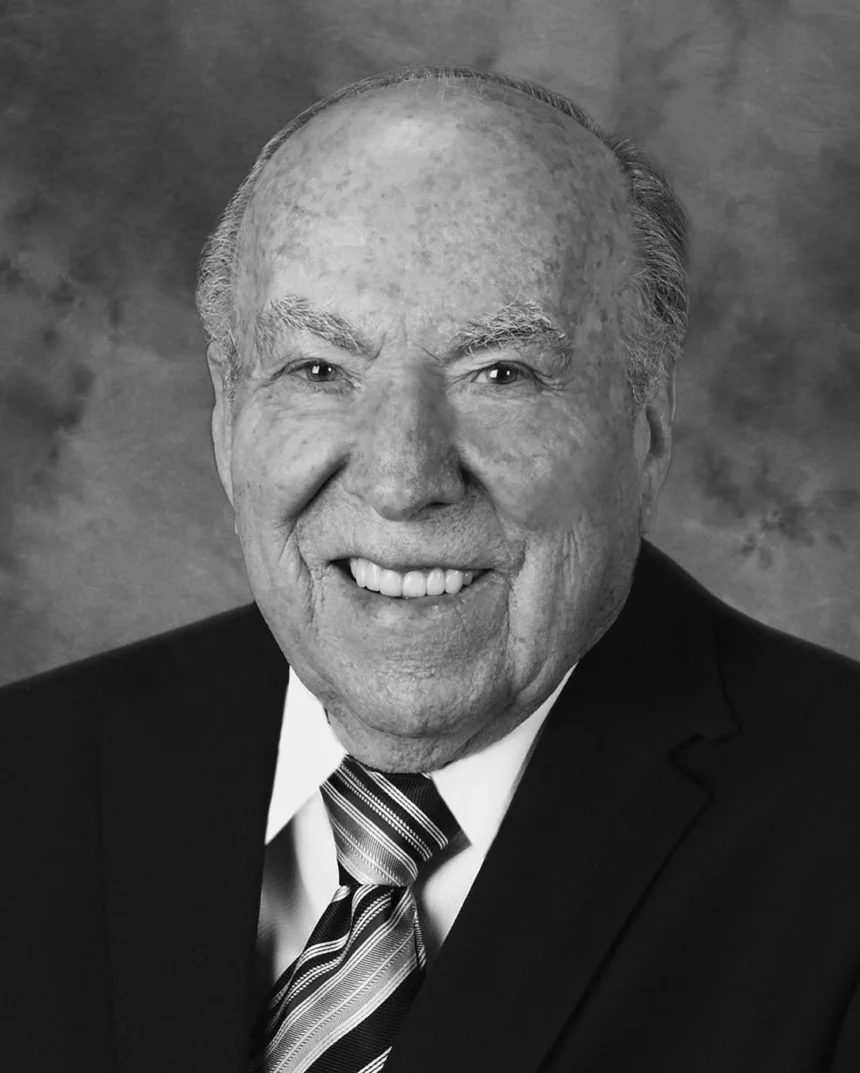
Some Calgary stories start with a plan. Sam Switzer’s started with a bicycle. At 13, that bicycle got him a job delivering prescriptions for a neighborhood pharmacy, and it is tempting, looking back, to see the whole shape of his life in that small errand: show up, carry the load, get it there. Switzer carried a great deal further than any pharmacy order over the decades that followed, and in 2021 the Southern Alberta Business Hall of Fame, run by Junior Achievement Southern Alberta, named him a laureate in recognition of it. He had died in 2018 at 92, so the honor arrived as a tribute to a life already told in full, and reading through it now, as detailed on JASAB’s laureate page, it is a life that says a great deal about the city he helped build.
A Childhood That Left No Room for Idleness
Switzer was born in Calgary to Jewish immigrants from Radom, Poland, parents who had crossed an ocean to outrun a horror that would soon consume relatives they left behind. There was no cushion of comfort waiting for the family here, and Switzer began working at age 5, a fact that still stops a reader cold. By 13 he had that bicycle and that pharmacy job, and somewhere in those early years of hustle he seems to have decided that opportunity was not something you waited for. It was something you went looking for, on two wheels if that was what you had.
That instinct carried him into adulthood with a kind of restless momentum. He was not a man who found one successful venture and stayed put. He opened a restaurant, then a jewelry store, then a car dealership on MacLeod Trail, each one a fresh bet on a city he clearly believed was going to keep growing.
The Builder Who Reshaped a Skyline
Where Switzer really left his mark was in construction and development. He built apartment buildings and shopping centers across Calgary at a time when the city was stretching outward in every direction, and he seemed to have a particular fondness for doing things that had not been done here before. He built The Summit, Calgary’s first round hotel, and paired it with Alberta’s first casino, a combination that must have raised a few eyebrows at the time. He followed that with the Elbow River Casino, another project that became a fixture of the city’s entertainment landscape for years.
None of this came from a business degree. Switzer never had the formal classroom training that so many of his peers in commercial real estate would have leaned on. He was, by every account, a self-taught student of the world around him, which made it all the sweeter when Mount Royal University later bestowed an honorary degree on him. Friends said it was one of the achievements he carried with the most pride, a piece of recognition from an institution he had never formally attended.
Giving Back Without Keeping Score
Switzer’s business record alone would fill a career. What rounds him out as a person is how much of that success he turned back toward the community. He funded bursaries for single mothers at Mount Royal University, supported men rebuilding their lives through Fresh Start Recovery, and backed cancer research at the Alberta Children’s Hospital. He gave to the Canadian Museum for Human Rights and helped rebuild and dedicate Heritage Park’s Little Synagogue, a project that spoke directly to the faith he practiced with real devotion throughout his life. Calgary Jewish Family Services, Habitat for Humanity, Magen David Adom and the Weizmann Institute of Science all counted him among their supporters as well.
His generosity did not stop at the Alberta border. In 2012 the Jewish National Fund honored him for his role in developing recyclable water systems in Sderot, a city in Israel’s Negev Desert, proof that his sense of responsibility to community stretched across continents. Closer to home, the City of Calgary recognized him with its White Hat award, a distinction reserved for people who have shaped the city in ways worth celebrating publicly.
A Legacy Still Standing
Drive past a shopping center, an apartment block or a casino built in Calgary’s boom decades and there is a decent chance Sam Switzer’s fingerprints are somewhere on the deal. He built the kind of infrastructure that a growing city needs but rarely stops to thank anyone for, and he gave away enough of what he earned that hospitals, universities and community organizations across two continents still carry a piece of his name in their history. His 2021 induction into the Southern Alberta Business Hall of Fame was not the start of his story. It was Calgary finally saying thank you to a man who spent nine decades saying yes to it.
What would Calgary’s skyline look like today without the risk takers like Sam Switzer who built it one bold idea at a time?