

A CPR Surveyor Named a Town After the Roman God of Fire 51 Years Before Star Trek Existed
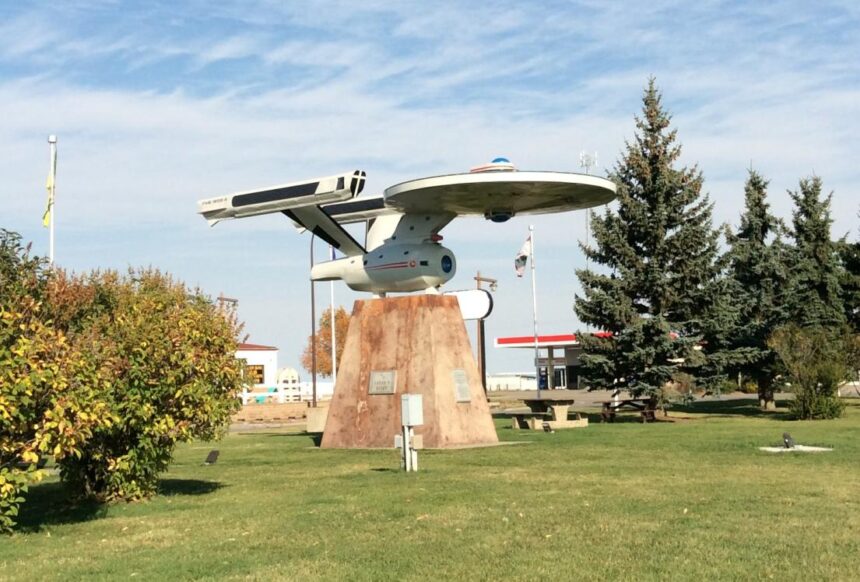
The town of Vulcan sits on Highway 23, halfway between Calgary and Lethbridge. Population about 1,800. Two grain elevators on the horizon. One famous tornado in the town’s archive. A starship parked beside the road.
The starship gets the photographs. Almost everything else gets missed.
The naming
In 1915 a Canadian Pacific Railway surveyor with a fondness for Roman mythology named the new siding Vulcan, after the god of fire and the forge. Then he kept going. Juno. Mars. Jupiter. The streets of the village, when it was incorporated on December 23, 1912, were named after gods and goddesses of the classical world the way a man with a working library and a slow rail car might. Vulcan was a town with a thesis statement before it had a sidewalk.
The CPR surveyors of the 1910s named towns at speed. Wheat country needed sidings, and sidings needed names. Most surveyors reached for the obvious. A railway executive, a postmaster’s wife, a hometown back east. The man at Vulcan was working from a different bookshelf entirely.
A tornado in the encyclopedia
In July 1927 a tornado tore through Vulcan and wrecked the new curling rink. A photograph taken of the funnel approaching the town ended up in the Encyclopaedia Britannica entry on tornadoes. For a few years in the late 1920s, Vulcan was the textbook image of a prairie storm.
The grain came in by the carload. Nine elevators stood along the rail line. Locals called them the Nine in a Line. One of them is still standing.
A hotel that travelled
Then there is the Imperial Hotel. It was built in Frank, Alberta in 1902. It was standing in Frank when 82 million tonnes of limestone slid off Turtle Mountain on April 29, 1903 and buried part of the town. The hotel survived. After a 1911 review concluded the mountain was still unstable, Frank’s surviving buildings were ordered moved or destroyed. Most travelled a few hundred metres. The Imperial Hotel was moved more than 100 kilometres. It ended up in Vulcan.
It is still there.
It is one Alberta story you almost never hear.
Spock arrives
Star Trek would not air on television until 1966. By the late 1980s, the small Alberta town that happened to share a name with a fictional planet was doing what every prairie farm town was doing. Trying to figure out what the next economy looked like.
A community group called VAST formed. The Vulcan Association for Science and Trek. The replica Starship Enterprise went up beside Highway 23 in 1995. The Trek Station opened on Centre Street in 1998. Leonard Nimoy visited in 2010 and put his handprint in concrete next to a bronze bust. What started as a coincidence became a tourism strategy. It worked. The town now hosts an annual convention that draws fans from around the world.
What survives
Vulcan is older than its starship. It is older than the curling rink, older than its tornado photograph, older than the Trek Station and the bronze bust and the painted concrete. It carries the name a Roman-mythology-loving railway surveyor gave it before the First World War, and it carries a hotel that survived a mountain coming down on top of it.
The starship gets the photographs. The town has the better story.