

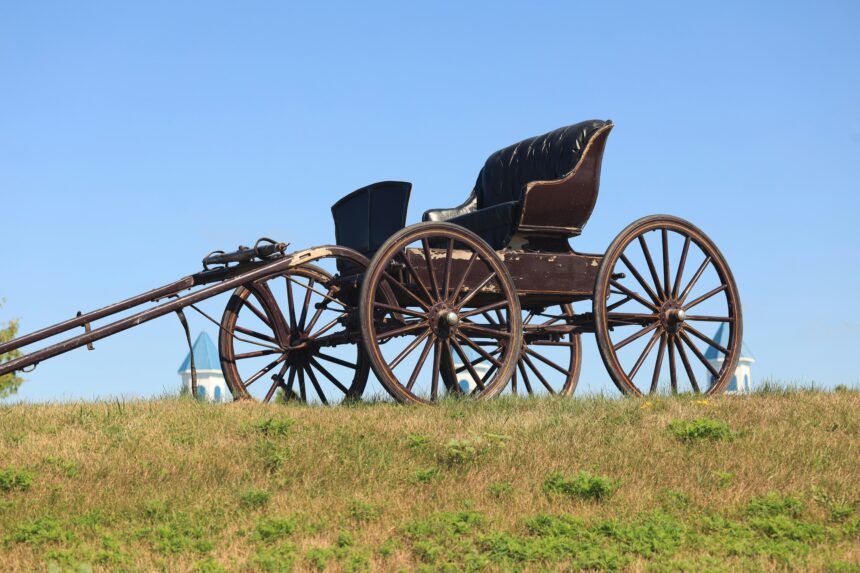
Nobody held a vote on the horse and buggy disappearing. There was no consultation, no transition plan and no committee. Within about two decades, Alberta roads that had run on horses ran on engines, and everybody adjusted whether they wanted to or not.
That is worth sitting with, because a great many people are currently arguing about artificial intelligence as though the decision is still in front of us.
Whole trades built on one technology
Farriers, saddlers, buggy builders and livery stables were not marginal businesses. In a prairie town of a few hundred people, they were core infrastructure. A man who shod horses had a skill that had been valuable for two thousand years and could reasonably expect his son to inherit the trade.
Then it was gone. Not because anybody voted against him, and not because the work stopped mattering, but because the thing the work served stopped being the thing people used. The livery stable in a lot of Alberta towns became the garage, sometimes in the same building, often run by the same family.
That last detail is the part usually left out of the story. The transition was not a clean replacement of one set of people by another. A large share of the people who had made a living on horses made a living on engines instead, because they were the ones who already understood moving freight, fixing machinery and running a service business in a small town.
The uncertainty is not fake
Nobody should pretend to know exactly what this technology means for a trade, for a farm operation, or for a fifteen year old picking a direction five years out. Anyone offering that certainty is selling something.
The concerns being raised are legitimate. Work that people trained years for is being done differently. Judgment is being handed to systems whose reasoning nobody can fully inspect. Fraud is getting cheaper to commit. Those are real and they deserve serious answers rather than reassurance.
What does not follow from any of that is the conclusion some people are reaching, which is that the correct response is to slow the thing down or stop it. That argument lost when the automobile showed up, and it lost for a structural reason rather than a moral one. The tool arrived faster than the debate about it could keep up. It is losing again now for the same reason.
What a province can actually decide
A jurisdiction the size of Alberta does not get to decide whether a general purpose technology exists. It never has. What it decides is the speed at which its own people learn to use one, and who captures the value when they do.
That is not a small consolation prize. It is most of the outcome. The provinces and states that came out of the automobile era ahead were not the ones that resisted longest. They were the ones that built the roads, trained the mechanics and figured out early what the new thing was actually good for.
Alberta’s energy industry is already running this technology in seismic interpretation and field operations, and has been for longer than the public conversation suggests. That is the pattern to notice. The adoption is happening in the places where it saves money, unnoticed by everyone except the people doing it.
Read the terrain, then move
Alberta was not built by people who waited for certainty. It was built by people who looked at conditions they did not control, made a judgment, and committed before the situation clarified. Sometimes that went badly. On balance, across a century, it went well enough to produce the province we have.
The failures are worth watching too, and the AI slop problem is a fair warning about what happens when a tool gets used without judgment attached. Adopting something early is not the same as adopting it carelessly.
The honest position is that this will cost some people something, that the province should be candid about that rather than cheerful, and that the answer is still to move rather than to wait. The buggy makers who did best were the ones who looked at the first automobile and asked what it would need, not the ones who wrote letters about it.
What would you want Alberta to have in place before this technology reaches your line of work?